

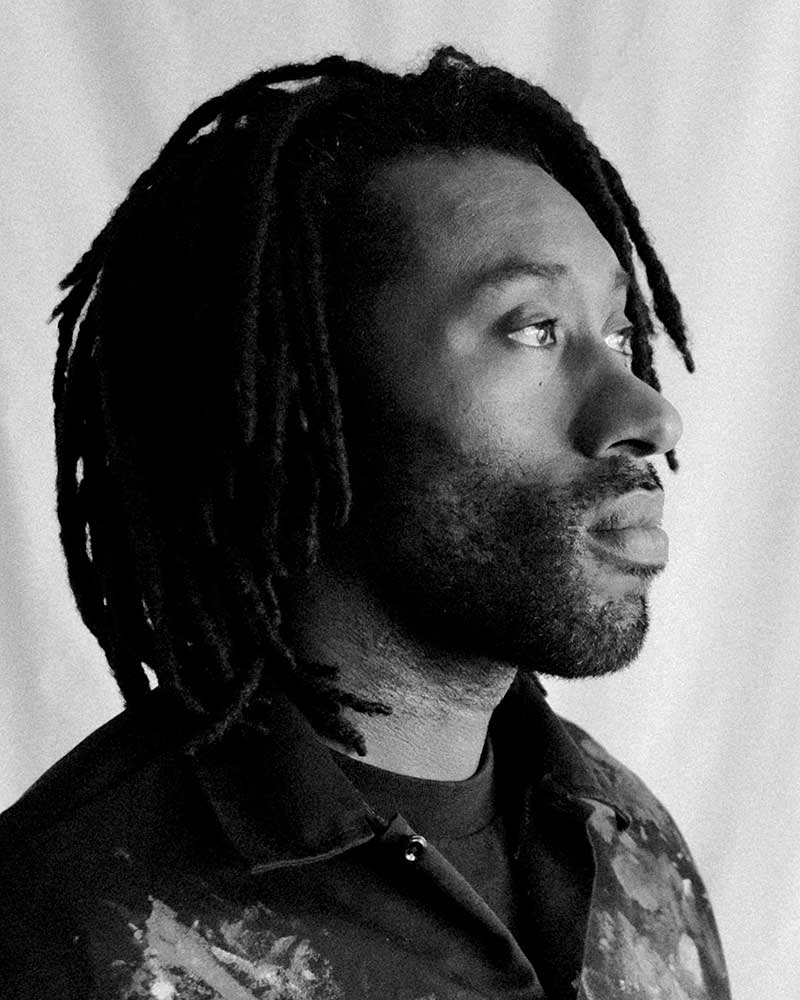
Chase R. McCurdy self-portrait, 2021
Chase R. McCurdy
Legacy, Abstraction and the Future of Art in Las Vegas
BY LAURA HENKEL
In the hush of early morning, Chase R. McCurdy moves through his home studio like a monk tending an altar. No notifications interrupt him. A biography of Paul Robeson lies open beside a teacup, not far from the studio notebooks of Jack Whitten and a well-worn Alice Coltrane vinyl sleeve. The soft hum of Coltrane glides through the light like a whispered mantra—slow, sacred and deliberate. A canvas rests silently under soft light, waiting. This is not a place of urgency. It is a chamber of patience, of intention. McCurdy doesn’t conquer the page. He listens until it speaks.
McCurdy’s home studio is lined with books—well-worn volumes on philosophy, history, revolutionary theory and art. These aren’t decorative objects. They’re lenses, like the ones he once looked through as a photographer—tools that sharpen perception, reveal what’s often missed and invite deeper focus. Each volume informs not just his visual work but the rhythm of his thoughts: how he composes a line of verse, assembles a sculpture or paints with spiritual resolve. He doesn’t just read them—he absorbs them. Pages are turned slowly, purposefully, as if each word might guide the next photograph, reconfigure the curve of a brushstroke or echo through the cadence of a manifesto yet to be shared.
ThirtyThree Gallery: A Threshold, Not a Venue
ThirtyThree Gallery (33.G), McCurdy’s intimate art space in the Historic Westside of Las Vegas, is a commercial gallery, one with deep cultural purpose. While it operates in the art market, it transcends typical conventions. It is not transactional at its core. It is a convener of artists, ideas and ancestors. When visiting the gallery, in the micro view, one cannot help but admire the precise use of space: thoughtful, restrained, quietly radiant. In the macro view, each exhibition unfolds like a movement in a symphony, layering memory, philosophy and community into something greater than the sum of its parts.
Public Art with Purpose: Reimagining Las Vegas Spaces
McCurdy’s work extends beyond gallery walls into the public sphere. Through mural projects, installations and collaborations with organizations such as the Mayor’s Fund for Las Vegas LIFE, his art intersects with city planning and civic imagination. One of the most notable examples is “Living Black Pillars” (2021), a stainless-steel installation at the Historic Westside Legacy Park.
Accompanied by a poem and dedication, the sculpture pays homage to the strength and resilience of the Historic Westside and the broader African American community. The text reads in part:
“Coming up from the soil / Reaching through the heavens, / Into the stars. / You remain with us / While giving us something, / somewhere… To look up, To.”
“Living Black Pillars” stands as both a spiritual offering and a communal beacon, reminding viewers of those who came before and the futures they helped make possible.
Rather than simply beautifying a space, his public artworks reclaim narrative, assert dignity and bring ancestral memory into contemporary environments. They are designed not just to be seen, but to be felt, remembered and carried forward. His vision for art in public spaces is about more than aesthetics. It’s about access, ownership and presence. Through his practice, he invites the community not only to witness art but to inhabit it—to see themselves reflected in it and empowered by it.
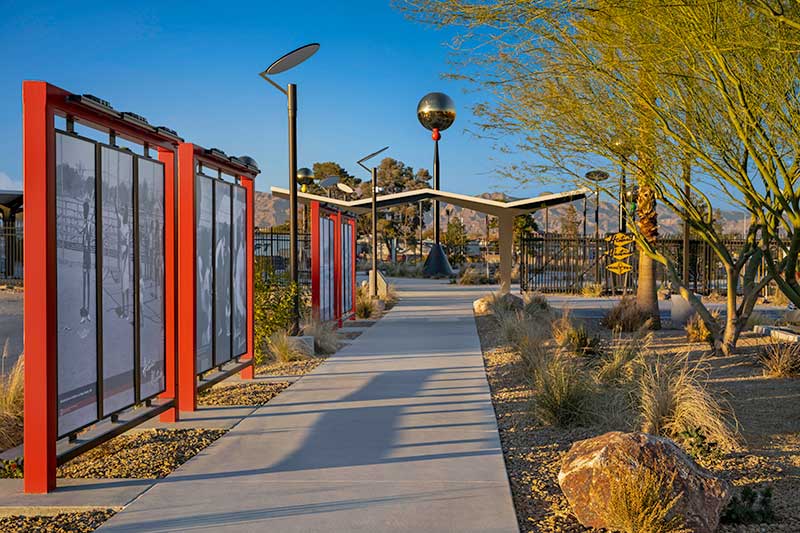
Photo of Historic Westside Legacy Park courtesy of Studio J Inc.
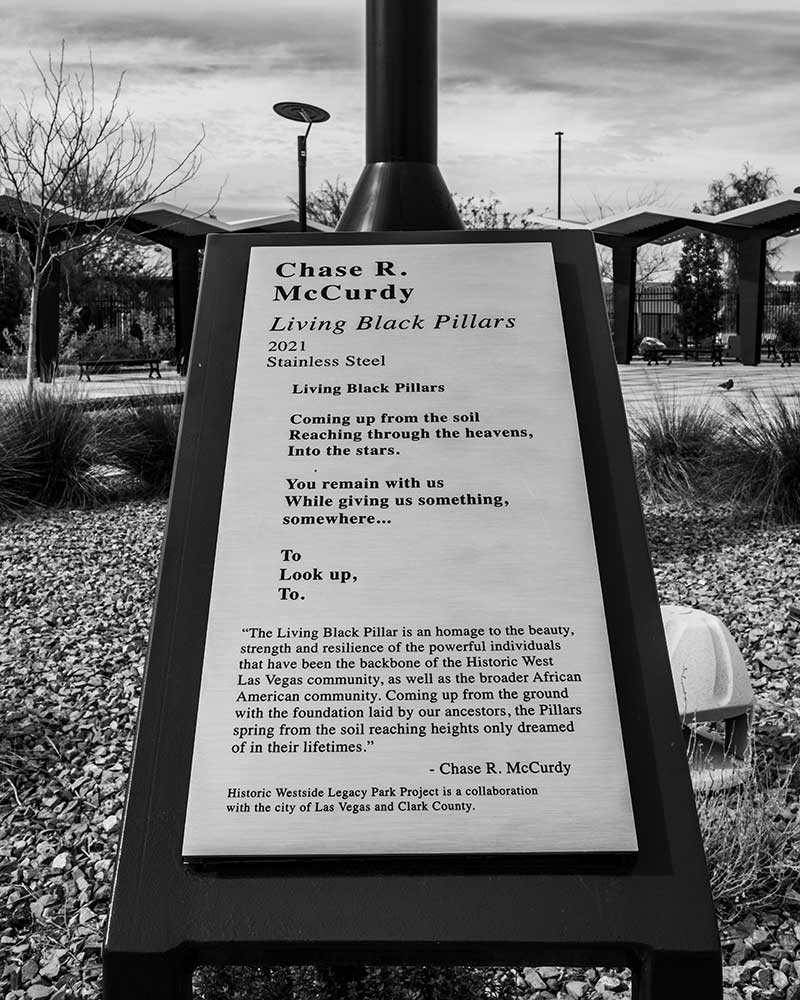
“Living Black Pillars” dedication plaque
A Day in the Life: Analog Spirit, Digital Distance
McCurdy has been known to go completely offline for extended stretches, not as a retreat, but as a form of resistance. In a world constantly calling for performance and speed, he chooses stillness. These digital sabbaticals are how he returns to himself: to his thoughts, his practice and his responsibility as an artist. He speaks of protecting the conditions under which meaningful work arises—not just guarding time, but energy. “The work comes when I make space for it,” he says. “I protect that space.”
This clarity shows in his every gesture. His mornings are deliberately unhurried: reading, sketching or listening to music only when it matches the day’s internal rhythm. His discipline is not about routine—it’s about reverence. His creative compass points inward, not toward algorithms but toward authenticity.
Spiritual Abstraction: The Art Behind the Art
Before picking up a paintbrush, McCurdy was a photographer. It was behind the lens that his artistic instincts first found form—observing light, capturing contrast, framing emotion. One of his most poignant images—titled “Y’all Got It, We Tired”—captures three Black women in motion, their uniforms marking them as hotel workers. Shot in high-contrast black and white, the photo blurs at the edges, as if time itself were speeding past them. In the background, the Trump Tower looms in soft focus, a silent witness to the labor that keeps the city running. The image hums with quiet resistance and dignity. It honors.
That image, much like his paintings and assemblages today, holds space for reflection. It doesn’t scream. It listens. Years passed before he transitioned into mixed media and painting. But for McCurdy, it wasn’t a pivot. It was a continuum. Photography taught him to see with precision. Painting allowed him to interpret with soul. Assemblage helped him hold the multiplicity. And his written work—what some might call a manifesto of liberation and legacy—offers yet another expression of his inward life made outward.
He describes his practice as a “physical manifestation of the spiritual.” It is not conceptual or performative; it is lived. Rooted in what he calls “spiritual abstraction,” his work arises from meditation, study and silence—not in pursuit of content, but in alignment with calling.
His creative lineage draws from artists and thinkers who made art inseparable from inner life: Jack Whitten, Norman Lewis, Alma Thomas, Romare Bearden, Gordon Parks. His artistic philosophy also resonates with the musical and spiritual legacy of Alice Coltrane—though her name, like his, stands not for genre but for transcendence. Rather than chase audiences, he cultivates intention. Rather than perform identity, he distills essence. “I don’t try to make art,” he has said. “If it doesn’t arrive naturally, I leave it.”
This commitment to inner clarity and spiritual presence was powerfully captured by Heather Harmon, executive director of the forthcoming Nevada Museum of Art, Las Vegas, and one of the state’s leading voices in contemporary arts and cultural development. In her essay “Spiritual Realignment,” published in “Threads in Time”—the exhibition catalog accompanying McCurdy’s 2021 solo show “Threads” at the Marjorie Barrick Museum of Art—Harmon reflects:
“When I consider McCurdy’s practice, I think of how it celebrates solace. In a world of chaos, he is a stoic reminder that you are the product of what you create. He shows us how to operate with purpose, to build with meaning. In being considerate viewers, we can face the same direction, soak in the work, bask in its generosity and feel the possibilities. Only then do you recompose and accept the spiritual realignment offered.”
As a desert-born artist, he often describes himself as a creature of terrain—hard on the exterior, soft within. That duality—resilience protecting the sacred—is at the heart of his work. He doesn’t posture. He doesn’t rush. He moves through the world with clarity and quiet strength.
“McCurdy is the positive injection Las Vegas has needed to progress fine arts in Las Vegas. He has a real prowess in learning about communities and audiences, and tailoring projects to meet their needs. During my time working with him on intergenerational art classes at the Neon Museum, I saw him move easily from talking about art with seniors to teens, always pushing them to learn more while providing a level of support they needed to be successful. His gallery, 33.G, and his own gifted practice have reinvigorated and brought meaningful attention to the Historic Westside; he is intentional in everything he does. Las Vegas and Southern Nevada are fortunate that he calls this place home. I continue to be awed by his art and his curatorial endeavors.” —Jennifer Kleven, deputy director of Parks, Recreation and Cultural Affairs for the City of Las Vegas
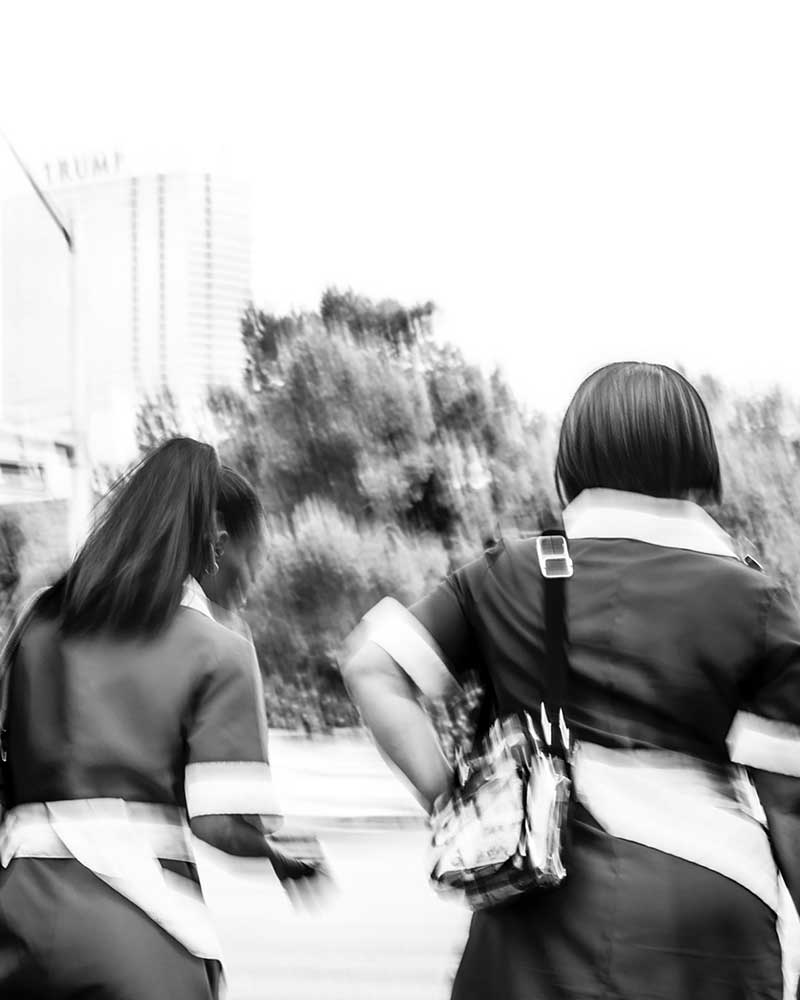
Above: Detail of “Y’all Got It…We Tired” original photograph, 2017
Landmark Exhibitions and Artistic Evolution
McCurdy’s 2021 exhibition “Threads in Time” at the Marjorie Barrick Museum of Art marked a significant evolution in his practice. Each artwork in the show was paired with a QR code, allowing visitors to access McCurdy’s own reflections, writings and insights connected to the piece. This fusion of text and image deepened the interpretive experience, inviting audiences to not only view the art but to enter into conversation with it. “Threads” exemplified McCurdy’s belief that art is not static—it’s living, layered and meant to be read as much as it is seen.
Among McCurdy’s most expansive undertakings to date is “Neo: The Birth,” exhibited at Left of Center Gallery in 2022. A retrospective of more than 60 drawings, paintings, writings and sculptural works, the exhibition brought together years of quiet labor and study. “This body of work was born from a desire for discovery,” he shared during the exhibition. “Discovery of the reality of both our physical and spiritual universe, and articulation of a philosophy of life for the human being of the future—one that draws from ancestral knowledge while staying awake to the world as it is.”
It was not only a visual testament but also a philosophical one—an invitation into a lifetime of thought, evolution and becoming. “Neo: The Birth” affirmed the arrival of an artist of enduring value. While rooted in community and legacy, these works possess the formal sophistication, spiritual resonance and philosophical clarity that serious collectors seek. Those who acquire them now are not only investing in beauty—they are preserving a voice that will echo for generations.
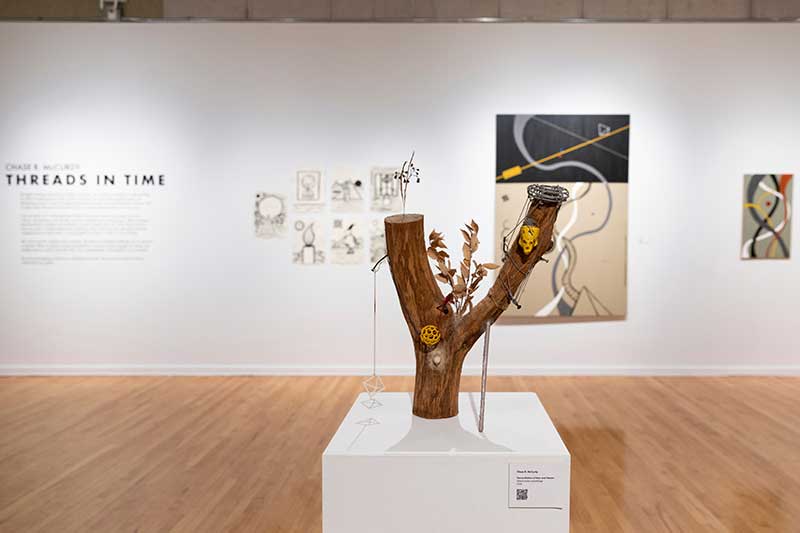
Photo of “Reconciliation of Man and Nature,” “Threads in Time” installation view courtesy of UNLV Barrick Museum
Past Exhibitions: Curating the Westside Narrative
McCurdy’s early curatorial work at 33.G has produced a vital timeline of Westside creativity. “Black Kings,” the gallery’s first contemporary show, featured McCurdy alongside two other artists with deep connections to the Historic Westside. This powerful opening was followed by “War at Home” and “Blue Magik,” each building on a shared vision of community, introspection and aesthetic rigor. These exhibitions, available for viewing at thirtythreegallery.com, underscore his belief that art is a form of social architecture, designed to uplift, challenge and unite.
Rooted in Legacy: The McCurdy-Moody Family’s Lasting Cultural Influence
McCurdy’s story is intimately entwined with the land on which he creates. He is a third-generation Las Vegan. His grandfather, Herman “Big Herm” Moody, moved to Las Vegas in 1939. In 1946, while the city was still deeply segregated, Moody became the first Black police officer. He served in that role for more than three decades, continuing to mentor officers long after retiring in 1977.
Since then, each generation of matriarchs and patriarchs of the McCurdy-Moody family has been a steady, quiet force in the city—educators, civic leaders, cultural contributors. Among them is his grandmother, Magnolia Moody, whose oral history is preserved in the UNLV Special Collections. A lifelong public servant and probation officer, Magnolia’s voice recounts not just the triumphs of a pioneering family, but the nuanced rhythms of raising a family in a segregated city, of nourishing community through wisdom, care and accountability.
They were never part of the glitz or flash of the Strip. They were the infrastructure of integrity beneath it: transcending barriers, opening doors, building a future by remaining grounded in truth. They walked with grace and purpose, not for the spotlight but for the community.
McCurdy walks in that lineage. His work does not demand attention. It commands respect. The dignity, vision and perseverance embedded in his family history are not only legible in his artistic output but innate to his character. He moves with intention, humility and clarity—qualities imparted by the legacy of his grandparents and shaped daily by the integrity of his parents, both of whom have also dedicated their lives to public service, education and cultural advocacy in Las Vegas.
In many ways, McCurdy’s creative expression is not a departure from that lineage but a continuation—his own offering in a foundation of service, truth and beauty.
A Reluctant Artist, A Committed Practitioner
He spent years resisting the idea of being an artist. For him, “artist” wasn’t a title to flaunt—it was a responsibility to live up to. “I never wanted to be an artist,” he says. “It’s a great responsibility, the potential impact on others. I didn’t want to take that lightly.”
Even before revealing his own work, he taught. He shared his skills with youth and elders alike—from photography and writing to design and digital media. Teaching became his first form of artmaking, a way of contributing before ever exhibiting. He taught at the Doolittle Senior Center, MLK Senior Center, West Las Vegas Arts Center and Marble Manor. “I’m just bringing what I can,” he says. “Not trying to build the whole thing—just making sure my contribution is strong enough to be useful.”
A Journey Through Elsewhere
Before returning to Las Vegas to teach and share his work publicly, McCurdy’s creative journey took him across states and continents. After early career experiences working in corporate strategy at MGM Resorts and briefly considering law enforcement, he realized those paths didn’t align with his deeper calling. He relocated to Los Angeles at age 23, with no formal training, and found refuge in photography, capturing fashion and music as a form of emotional and cultural inquiry.
From there, he spent time in Paris, studying art and theory, reflecting on legacy and confronting the responsibilities of voice and vision. Those years abroad were not about self-promotion but self-examination. It was in that stillness, far from home, that he began to crystallize the path he now walks. “You learn something, you go out and experience things,” he says. “But then it’s your duty to take that home and do something positive with it.”
The Legacy Continues
His journey—at once personal and collective, internal and expansive—stands as a testament to what’s possible when art, community and conviction move in unison. Through silence, presence and patient creation, McCurdy reveals that legacy is not what we leave behind. It’s what we live forward. It’s quiet. It’s powerful. And it’s still growing.