


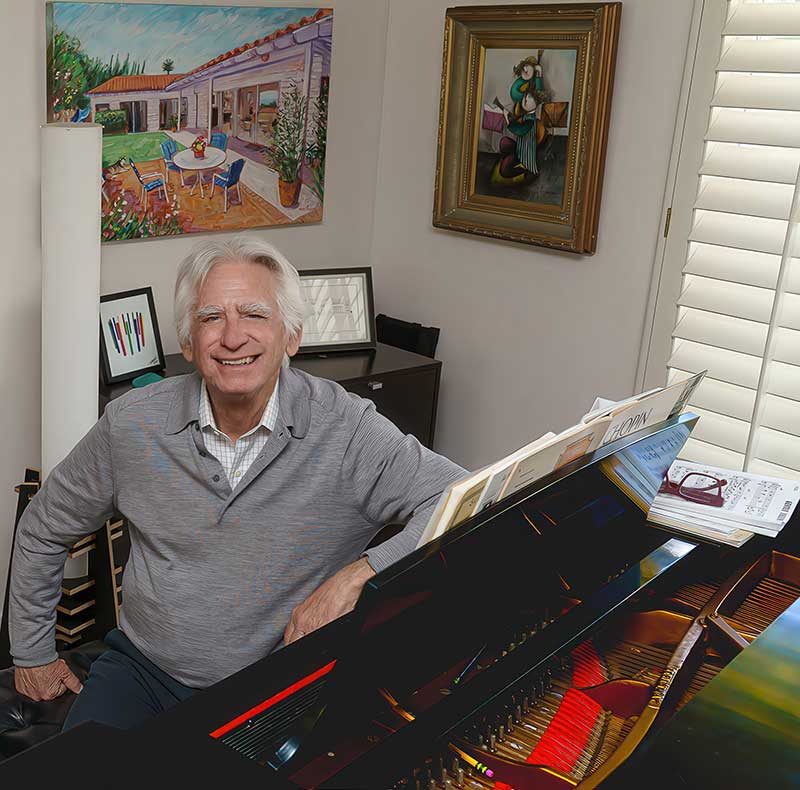
David Benoit
David Benoit Instills Integrity and Feeling Good in All His Music
BY SHERYL ARONSON / PHOTOGRAPHY BY SASAPHOTOS (SHERYL ARONSON & SHERMAN ALFORD)
David Benoit’s creative spirit burst forth as he composed “The Three-Finger Waltz” at age 6 and, at 11, wrote a composition for bassoon and harpsichord. Music seemed to flow through Benoit’s veins because his father, Robert Bryan Benoit, played jazz guitar and exposed his son to jazz music.
Benoit’s career path in the music industry seemed to be a combination of serendipitous opportunities that uncovered and revealed his tremendous talents as an artist, composer and conductor. One example: He first nailed the job as Lainie Kazan’s accompanist when her original guy couldn’t make the tour; Benoit took over.
“That was happenstance. Lainie Kazan had a last-minute cancellation of her accompanist for her tour of Canada with the Duke Ellington Orchestra. I knew the guitar player, so I jumped into the gig without a lot of preparation. She liked the way I played, and eventually I became her conductor and musical director.”
Another example of the universe opening a space for his talent was when he worked with the legendary Ann-Margret. Benoit fondly recalls, “It was another last-minute gig. Ann needed a keyboard player, and she hired me for the job. We toured South Africa and Botswana to the resort called Sun City. Ann-Margret was lovely to work with.”
Touting an impressive résumé in the music industry, Benoit has five Grammy nominations during a four-decade-long successful career as one of the founding fathers of contemporary jazz. In addition, he claims 41 solo recordings over the past 40 years, including his 1987 GRP Records debut “Freedom at Midnight” and its Grammy-nominated 1988 follow-up “Every Step of the Way,” considered influential classics in the genre. He has also been a conductor with a wide range of symphony orchestras, including the Los Angeles Philharmonic, San Francisco Symphony, Atlanta Symphony, Dresden Philharmonic, London Symphony, Nuremberg Symphony, Philippine Philharmonic, Long Beach Symphony Pops Orchestra and, most recently, the Asia America Symphony Orchestra.
Benoit also brought his talents to film and television, with one of his most cherished roles being his work with Charles Schulz and the iconic “Peanuts” franchise, composing music for more than a decade of CBS TV specials.
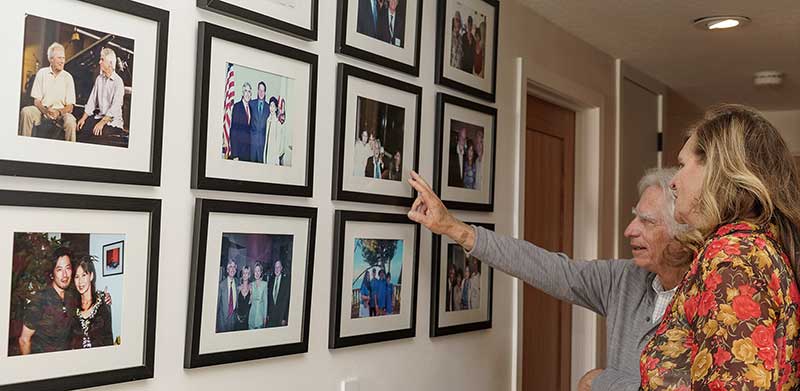
David Benoit reminisces with Sheryl Aronson
Benoit spoke about his first meeting with him: “I got to meet Sparky (Charles Schulz’s nickname). I had been a fan from the time I was 8 years old. I read the comic strip every day. I identified with Charlie Brown and his struggles. To be sitting there having lunch with Charles Schulz when he says, ‘Call me Sparky,’ is still a memorable experience.”
What was evident in my interview with Benoit was his passion to instill musical integrity and sophistication into every composition he composes—and, at the same time, infuse melodic “feeling good” music that fills his audience’s listening ears. I sat with him at his home in Laguna Niguel as we talked about his 40-year career and his passion for architecture.
Chic Compass: What was your early training as a musician?
David Benoit: I didn’t have a lot of training. I think of myself as self-taught, since there were lots of teachers and mentors along the way. My dad was a big influence. He was a jazz guitarist and so he’d have jazz musicians over to the house. As I got older, I had my first piano teacher when I was 13, and he was into jazz, so I didn’t study classical piano until I was well into high school.
Chic Compass: You were playing and studying jazz. Were you part of the big band in high school?
David Benoit: I wasn’t in the big band. I would find musicians in high school to jam with. I got used to being a bit of an outcast and coming up in jazz in a very unconventional way. The good news is that, as a result, I developed my own unique sound.
I grew up in Hermosa Beach, California, where it was all about surfing and not a big emphasis on music. To get into music, I felt I needed to move up to Hollywood. After a semester of college at El Camino, I made the move and started meeting people and networking. One of my early gigs was with an R&B and jazz singer named Gloria Lynn; we played at the Parisian Room in Los Angeles. I was the only white person in the club, and I was about 21. Everyone accepted me with open arms. In fact, Leonard Feather even came by and gave us a nice review. That’s how I became known as an accompanist for singers.
Chic Compass: You’re a five-time Grammy-nominated musician and have a vast repertoire of music. Talk about your composing career.
David Benoit: The first was when I was 6. It was called “The Three-Finger Waltz.” My uncle played the bassoon, so I wrote a piece for bassoon and harpsichord when I was about 11. I had a chance opportunity to work with Frank Zappa’s band, The Grand Wazoo. I had a girlfriend who was playing in his band, and she said, “He’s rehearsing this band. I think he might be open to reading your chart.” I spoke with Frank, and he was very nice. He asked me if I had brought my music, and I said “yes.” They just did a little rundown of it.
I also put on a concert with a full orchestra at Wadsworth Theatre, UCLA. The big change for me was when I made a digital recording called “This Side Up” with Jeffrey Weber, and we recorded it live at Ocean Way Studios. We put on a little song called “Linus and Lucy.” This went right to No. 1.
I wanted to share this because it was that one moment in my career where my whole life changed. I’m at my place in Manhattan Beach, and there’s a message on my answering machine: “This is Larry Rosen, and we want to sign you to GRP Records. I want you to meet with Dave and me in New York.”
Dave being Dave Grusin, of all people.
Dave was one of my heroes. I modeled my sound after his: orchestral, melodic, and elegant. The first meeting was in New York, but the second meeting was when they wanted to hear my music. Larry said, “Meet me at this hotel,” and I get there, knock on the door, and Dave Grusin answers the door. I had to go into the bathroom to contain myself. That was such a life-changing event for me and was the big launching point for my career.
GRP was amazing, especially at the time when they were so hot. That was the place to be when CDs were first introduced. Chick Corea was on the label, along with Eddie Daniels, Dave Grusin, The Rippingtons, Lee Ritenour and Dave Valentin.
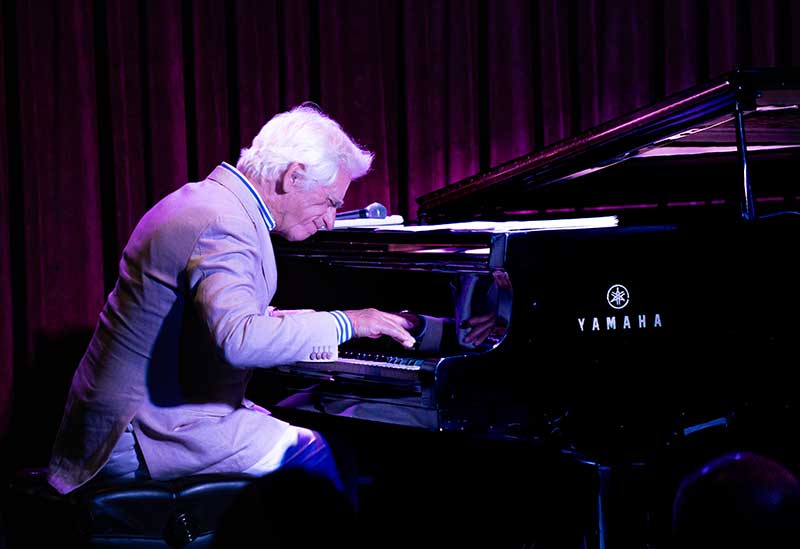
David Benoit on the piano at the Catalina Bar & Grill Jazz Club
Chic Compass: You’ve put out many albums. What are some of the ones that stand out?
David Benoit: The first GRP record was a big hit for me, “Freedom at Midnight,” and that title song has become a standard for smooth jazz. That was written by me and Nathan East, the great bass player. Of course, “Kei’s Song” was on that record and was a real defining album, and then “Waiting for Spring,” which was my first straight-ahead jazz album with Emily Remler, John Patitucci and Peter Erskine. It went to No. 1 in the country on traditional jazz. That was very huge for me because GRP didn’t want me to do the album, since my sound had been more contemporary jazz. I told Larry Rosen that I had to do this, and GRP gave me a small budget. Strangely enough, it became one of my best-selling records. I think this is Larry Rosen’s genius; he was a great record man. He told me, “We need something on this record that’s very catchy that we can go to radio with.” I said, “Well, how about ‘Cast Your Fate to the Wind’?” I took the approach of playing it very simply and didn’t try to reinvent it.
Chic Compass: We’re using the words “smooth” jazz and “straight-ahead” jazz. Your career reflects both genres. Why are both genres important to the music industry?
David Benoit: When I was growing up, before it got so divided, I think there were a lot of artists like Lee Ritenour, Chick Corea and Herbie Hancock who did both. Even Miles Davis wanted to be a rock star and used those funky rhythms. Being a DJ on KJazz, I listen to a lot of jazz, and some of the music seems to be intended for other musicians—very intellectual and dissonant. I grew up in a time when Wes Montgomery was covering Beatles tunes, and now it seems like people look down their noses at that. The jazz artists back then were trying to have a broader appeal. However, with smooth jazz, the musical content has gotten a bit lame, since there’s more emphasis on dancing and clapping hands than on the real music.
I was sitting in at a concert with Michael McDonald, and when he broke into “I Keep Forgettin'” and “Minute by Minute”—these are songs that had bridges and modulations. Even thinking about Vince Guaraldi—what a great bebop jazz pianist he was—before anyone knew he did the “Peanuts” music. I think the genius of music is how you can do something that has an intellectual bent, but then the average person who doesn’t know anything about music still loves the composition because it feels good. That’s always been my goal: how do you make music that feels good to others but still has integrity?
Chic Compass: Speaking of Vince Guaraldi, let’s talk about your relationship with Charles Schulz and the “Peanuts” characters.
David Benoit: That was another lucky moment. I told you about the “Linus and Lucy” composition. It caught the attention of Lee Mendelson, the producer of those shows. He called my agent and asked me to score one of the Charlie Brown episodes. It was a miniseries called “This Is America, Charlie Brown” for CBS, and they decided they wanted to bring back that Vince Guaraldi sound because the people producing the show were more traditional in their approach to scoring. I knew the music well. Lee and I just hit it off. After that, I started writing all the music for the TV shows.
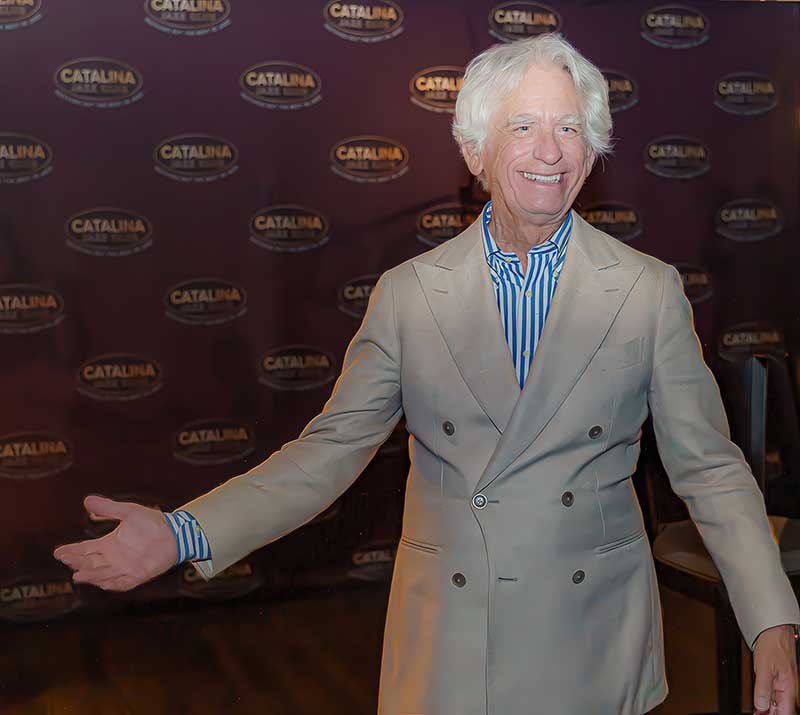
David Benoit at the Catalina Jazz Bar & Grill, Hollywood, CA
Chic Compass: Talk about your creative process when you are composing for the TV series.
David Benoit: They had these old bar sheets, which were very confusing and hard to read, and then they had the storyboard. It was kind of the old, primitive way to do it. Finally, they switched to video cassette, so I would take the tape, mark the time code, and start coming up with a little melody. I also listened to Vince’s music, and the nice thing was that Charles Schulz said, “Write your own music.” So, I wrote original music for a few of the shows. When Sparky died, that’s when Mendelson decided it was just going to be Vince Guaraldi’s music. At that point, I would come up with arrangements, or I’d get a cue that would fit a scene, but the composition needed to be Vince’s.
Chic Compass: You’ve had five Grammy nominations. What has that meant to you?
David Benoit: I haven’t won yet, but to be nominated is quite an honor. I’m very happy about the nominations. I think the one I was most proud of was when I got nominated for the composition called “Dad’s Room,” which I wrote for my father after he suffered a stroke. I remember he was in a rest home, and I was able to share the news with him.
Chic Compass: You’ve also worked as a conductor with symphony orchestras. How did you develop yourself as a conductor?
David Benoit: I think the early beginnings were when I was Lainie Kazan’s rehearsal pianist. After playing with her for a while, she asked if I had ever conducted an orchestra. One night, the pianist who usually played with her couldn’t make it, so I subbed. I got lucky and somehow knew how to conduct the orchestra. But the second night was a lot rougher. I realized I wasn’t an experienced conductor. Lainie gave me a ton of notes to prove that point.
I studied conducting independently at UCLA with John Robertson, Ph.D., and it felt like I had to take it seriously. I’m left-handed, so I started conducting with my left hand. I remember a few orchestras complained, so I learned how to do it with my right hand.
I scored a film produced by Clint Eastwood, “The Stars Fell on Henrietta.” The producers were saying we should get a conductor, and I told them I’d like to be in front of the orchestra and conduct the score. Clint had a couple of my records, so he was kind of a fan and said it was fine. That’s another moment I remember. I was on the Clint Eastwood scoring stage at Warner Bros., and there were 60 musicians. I was trembling. Clint was in the control room, and there was a big screen. Unfortunately, the movie itself didn’t do that well, but I remember picking up a book that listed my score among the 100 best film scores. I was hoping at that point that conducting would become my career, but it didn’t really go that way. I had about five years where I was scoring films and TV shows, but it’s a very tough business. I wasn’t willing to give up my performance career, which is dear to me.
Chic Compass: You also developed yourself as a symphony conductor.
David Benoit: I wrote a symphony piece called “Kobe.” I spent 10 years writing it and was looking for people to help me. I found an ally in Kent Nagano, the great conductor from California. He helped me with it, and I was looking for a place to debut it. My wife was on the board of the Asia American Symphony Orchestra. She told me, “I think they want you to do a fundraiser and bring your band to play a few tunes.” I asked them about debuting this symphony work with the orchestra.
The conductor at the time was very strict and classical-oriented, but the Asia Symphony needed to fill the house with an audience. Playing strictly classical music didn’t fit the bill. The board members said they wanted pop music, Gershwin, etc. When I went to their board meeting, they told me, “We want you to be the music director.”
I was astounded. I’m not Asian. I had never conducted a symphony orchestra before. They also said they wanted a youth program, so I formed the Asia America Youth Symphony.
The little youth orchestra really began to take off. One of our astounding performances was Beethoven’s “Ninth Symphony,” and we received a great review from Mark Swed, music critic from the Los Angeles Times. I had 21 years with that orchestra, and I would debut a composition of mine every year.
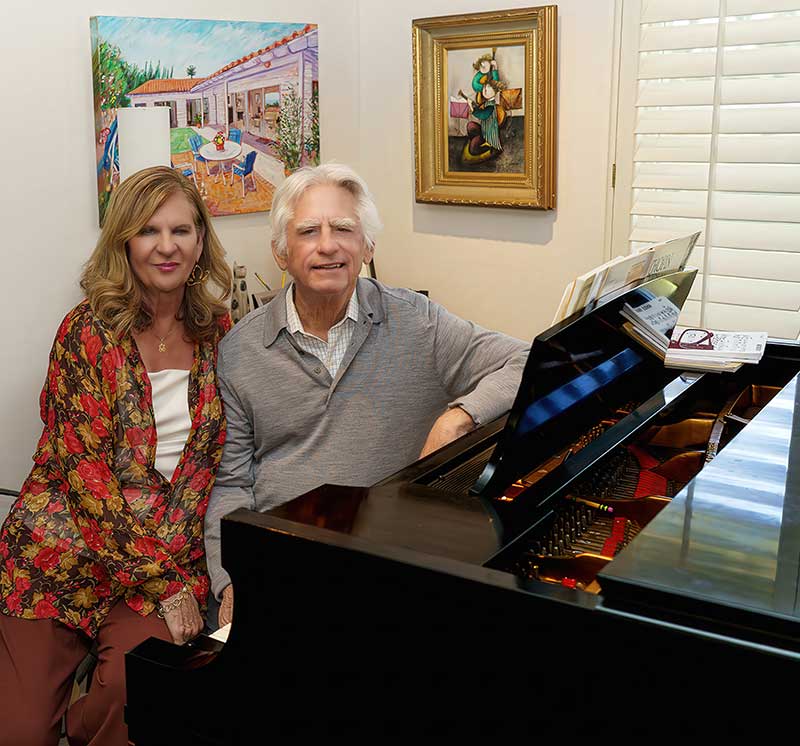
Sheryl Aronson with David Benoit
Chic Compass: Let’s switch gears. Two years ago, you had a big change in your life.
David Benoit: Yes. Backing up a little bit, at the height of my career, my wife and I built our dream home: a 5,000-square-foot house overlooking the ocean. Another hobby of mine from the very beginning, even as a kid, was architecture. Our architect wanted to go Mediterranean, and I told him, “We’re going contemporary, something more Frank Lloyd Wright, Prairie style.” We built it and hosted a lot of music events there. Life was going very well, and then I did a tour with Dave Koz. After that tour, I was in the hospital. I had pretty much thrashed my kidneys due to high blood pressure that had gone unchecked and an unhealthy lifestyle. The next 10 years were about keeping those kidneys healthy with a strict diet.
After a few years, we couldn’t manage the house anymore because my health prevented me from performing as much. We decided to downsize. Then, on a trip to Italy, I was very tired and couldn’t eat. When I got back home, they put me on dialysis the next day. I was on hemodialysis for eight months. In the meantime, I was on the list to get a kidney, and my wife came through for me. She said, “I’ll donate mine.” (We weren’t a match.) So we entered the paired exchange program at UCLA. I got my new kidney two years ago! I’m feeling better every day. We wanted to start fresh and do something different, so we found this wonderful community here in Laguna Niguel.
Chic Compass: That’s where we’re sitting right now. What else have you been doing?
David Benoit: I had started with this little musical idea while on vacation in Italy. Then, when I got out of the hospital and needed to recover, I felt I should write something about the last year of the Youth Orchestra. We had this handsome young boy from Ukraine, and when the war started, I got to know his family. The grandmother looked at me and said, “Why don’t you write a cello concerto for my grandson?” I said OK. I started working on it, and I just finished it a few months ago. The next big step is finding a cellist and an orchestra.
Chic Compass: What’s new on the horizon for your jazz music?
David Benoit: I released my first big band album last year called “Timeless,” and it features an 18-piece big band from London called Spice Fusion. We recorded it live at a women’s college that has a great studio in the performing arts center.
Chic Compass: Lastly, talk about being a DJ on KJazz radio.
David Benoit: The owner of KJazz, Saul Levine, is a wonderful, sweetheart of a man. He heard me being interviewed at the station and said, “I like your voice. I want you to be an on-air personality.” This was 13 years ago. Saul thought I’d do well. I said, “Saul, I’m more smooth jazz/contemporary jazz—not straight-ahead jazz.” And he—being a very wise man—said, “Those jazz police? That’s a small number.”
Jazz is all the stuff I love, like Wes Montgomery, Vince Guaraldi, Bill Evans, Oscar Peterson and Stan Getz. The station represents all the different facets of jazz, whether it be intellectual, spunky, melodic or out there.
Chic Compass: Of course, some David Benoit.
David Benoit: It’s always nice when I see my name on the playlist.