

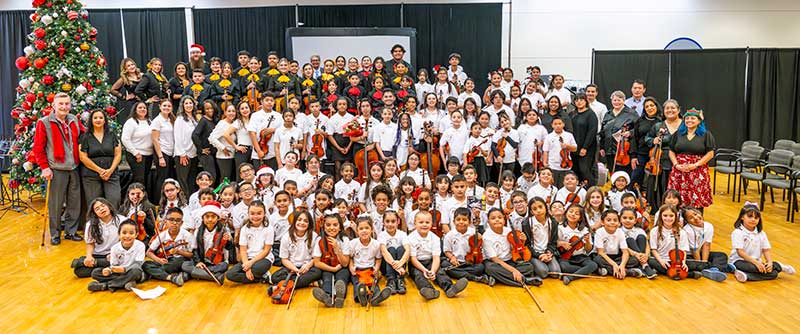
“FAYM-ster Stars” at the 2024 winter concert (Richard Brusky)
FAYM and the Power of Music
BY KENDALL HARDIN / PHOTOGRAPHY COURTESY OF FAYM
After retiring as the founding music director and conductor laureate of the Las Vegas Philharmonic in 2007, Hal Weller didn’t exactly lay down his baton.
Two years later, he launched FAYM — the Foundation to Assist Young Musicians — as an organization to offer scholarships and mentoring to young, rising-star musicians pursuing their careers.
He was joined in this venture by opera diva Luana DeVol and the late Marilyn Laroque, a longtime friend of Weller who championed classical music. Together, they secured pro bono legal assistance and arranged concert venues for the first wave of scholarship students.
Catapulting Rising Stars
Winning the first scholarship was 18-year-old violinist Krzysztof (Kris) Rucinski from Poznan, Poland, whom Weller urged to apply to the prestigious Eastman School of Music in Rochester, New York. At the end of 2007, Rucinski flew to the United States, where he performed recitals in Las Vegas, Flagstaff and Sedona to rave reviews.
He won the Howard Hanson Scholarship to Eastman at $30,000 per year, with FAYM raising the remaining $20,000 annually until he graduated with high honors in 2012. He went on to receive his master’s degree from the Carnegie Mellon School of Music in Pittsburgh. Today, Rucinski is a tenured member of the Ulster Philharmonic in Belfast, Northern Ireland.
Other scholarship recipients followed, including pianist Igor Lipinski, currently on the faculty of the University of Texas at Austin; violinist Liam Mansfield, a graduate of the Jacobs School of Music at Indiana University and now a member of the Helsinki Philharmonic; and pianist Corbin Beisner, a graduate of the Hartt School of Music in Hartford, Connecticut, who is currently a soloist performing throughout Europe and the United States.
Violins for Kids Is Born
Two years after its inception, FAYM created Violins for Kids (V4K), designed for underserved students who traditionally would not be exposed to classical music and could not afford training at an early age.
The program provides youngsters with instruments, materials, two to four weekly class lessons, a tuition-free weeklong summer camp experience in June and special musical trips. Private instruction is offered to those who qualify through audition. Classes range primarily from first through eighth grade, with several advanced students continuing through high school.
The V4K program has evolved from two volunteer teachers and 12 students at one school to 11 paid teachers, three student assistants, and nearly 300 students from 51 schools in Southern Nevada.
Lessons are held on the east side of town at the East Las Vegas Community Center and East Las Vegas Library, and on the west side at the Pearson Center. The Las Vegas City Council waives rental costs for the east-side locations, and the Clark County Commission waives the rental fee for the Pearson Center.
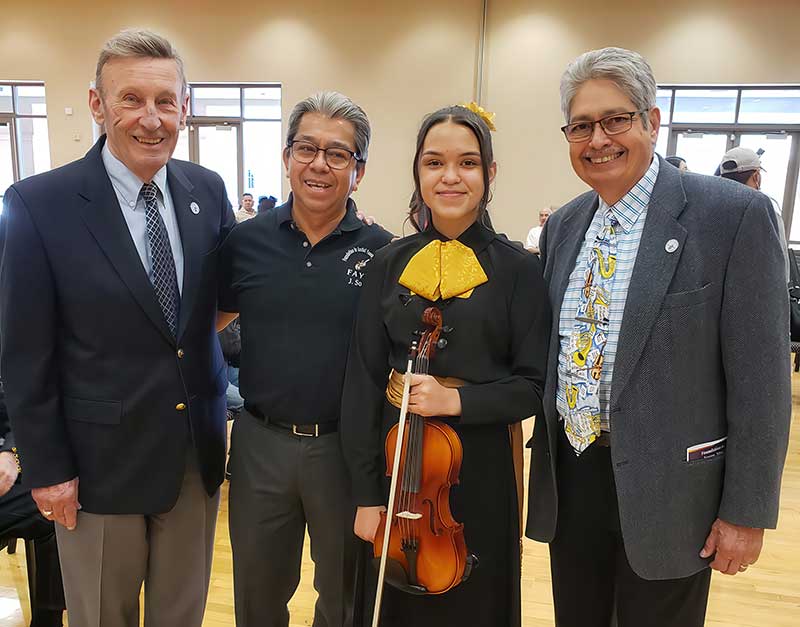
Hal Weller, Jose Soto and Art Ochoa present Mariana Carbajal with her well-earned Golden Violin.
Inventing a New Kind of Model
From the beginning, it was FAYM’s goal to change the paradigm from the typical business model. As a nonprofit organization, it is astonishing that FAYM has no office, classroom rental or CEO expense, as all support is donated.
All instruments are purchased at wholesale cost, thanks to Juan Soto, proprietor of the Mariachi Depot in the Boulevard Mall, who also donates the cost of all repairs on FAYM’s instruments. All support services, such as accounting, legal, secretarial and web design, are donated pro bono by qualified volunteers and board members.
For every dollar donated to FAYM, 95 cents goes to the mission of securing more scholarships, instruments, training materials and teacher wages. FAYM’s budget for this year has grown to over $220,000.
Since its founding, FAYM has received contributions from donors in 31 states and the District of Columbia, as well as from Australia, Canada, China, Colombia, East Java, Germany, Greece, Italy, Japan, Poland, Puerto Rico, Sardinia, Sweden, Switzerland and the United Kingdom.
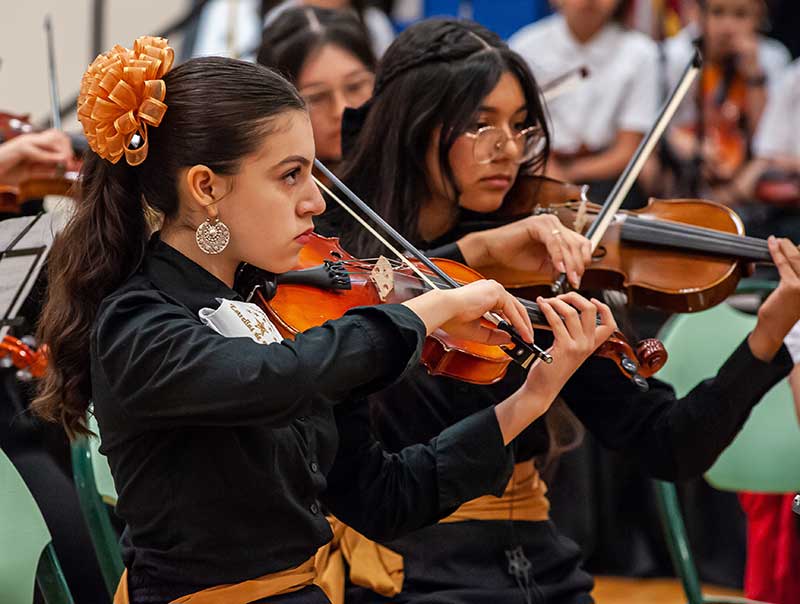
Mariachi Estrellas de FAYM musicians, like Sofia Rodriquez and Hilda Cortez, must perform repertoire from memory
How the V4K Program Works
V4K targets schools in low-income areas, primarily serving underserved students of color. First-year students are recruited along with their parents, who are required to attend classes and learn to play the violin alongside their child.
The children receive small violins and bows in a case, while their parents receive a full-sized violin. At recitals, parents and children perform side by side. Students’ first lesson before using their violin is how to make a proper bow to the audience in unison.
After two or more years of lessons, youngsters can audition to become part of the Mariachi Estrellas de FAYM orchestra or several FAYM string orchestras, including a cello orchestra.
As students become more proficient in mastering the violin, they can also apply for “Golden Violin” status, which requires submitting an essay on their desire to advance musically and auditioning before a panel of evaluators.
If the panel recommends the student, the young musician is allowed to choose from a collection of higher-value “golden violins” valued at up to $2,000 to accompany them on their musical journey.
Each June, the tuition-free weeklong summer camp offers students multiple string orchestras, mariachi ensembles, instrumental training, percussion and rhythm classes, and fun electives.
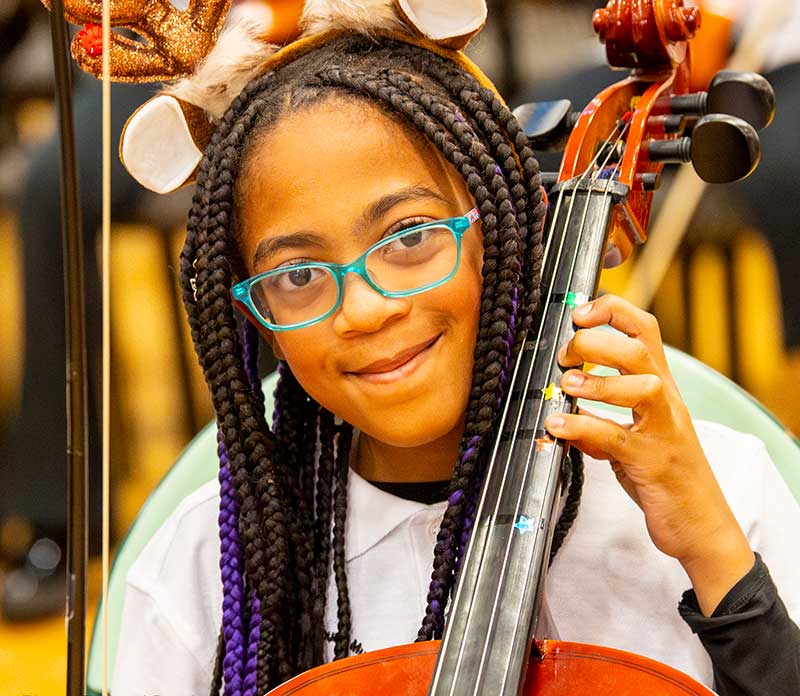
Cellist Riley Hislop performs in style at the 2024 winter concert (Richard Brusky)
FAYM’s Impact on Kids and Families
Arturo “Art” Ochoa and Weller joined forces as the ideal pair to invent this unique program. The two men launched V4K with Weller’s professional credentials, contacts and fundraising acumen, complemented by Ochoa’s dedicated programming experience.
As a former teacher and principal in Henderson and the inner city, Ochoa created after-school music programs that gave underserved children a safe place to be, helping them avoid after-school distractions in their neighborhoods. The astonishing results of his Suzuki violin training for kindergarten and first-grade students immediately validated the potential of kids learning music at a young age.
Weller heard about Ochoa’s programs to “make tomorrow’s Philharmonic” and visited the classrooms to see firsthand how kids were excelling not only in music but academically in all subjects.
“I committed my educational career to making sure that impoverished students did not fall through the cracks as I did,” said Ochoa, himself a high school dropout who later earned a GED, an undergraduate degree in education and a master’s degree in educational administration.
“The advantages of early music education are amazing,” he underscored. “It builds teamwork, self-confidence and self-worth, along with social skills and the ability to succeed. It engages kids in learning how to learn alongside their peers. Putting kids on stage is a powerful motivator.
“I didn’t expect the Violins for Kids program to create an academy of professional musicians, although several of our gifted students have gone on to forge careers in music,” Ochoa said. “I was focused on creating the next wave of professional teachers, lawyers, doctors and entrepreneurs through improved academic excellence for at-risk students.”
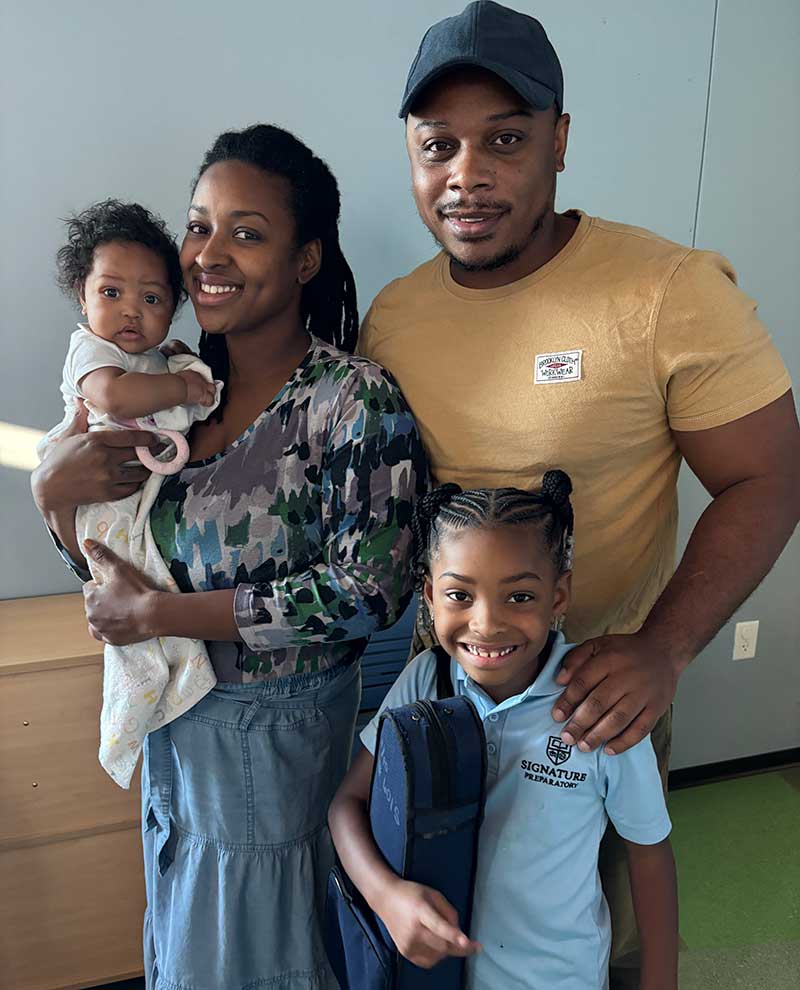
Zendayah Poindexter’s whole family celebrated new violins for her and her dad
Building a Legacy on FAYM’s Horizon
This November, FAYM enters its 18th year with new possibilities and challenges. FAYM is ready to expand into North Las Vegas and the south end of town if donated space can be secured. FAYM also needs a centralized administrative office and storage space to house its instruments and teaching materials as it serves more students throughout the Vegas Valley.
The FAYM board, currently chaired by Ochoa, is considering creating V4K “in a box” as a turnkey module program to sell to other cities so they can replicate the unique success of FAYM.
As Jamie Bernstein, daughter of conductor-composer Leonard Bernstein, summarized on her visit to Las Vegas, “FAYM is about so much more than learning a musical instrument. It’s about giving kids a chance to see themselves as worthy, capable and beautiful. And that, in turn, helps them become the wise, compassionate citizens of tomorrow who will make the world a better place.”
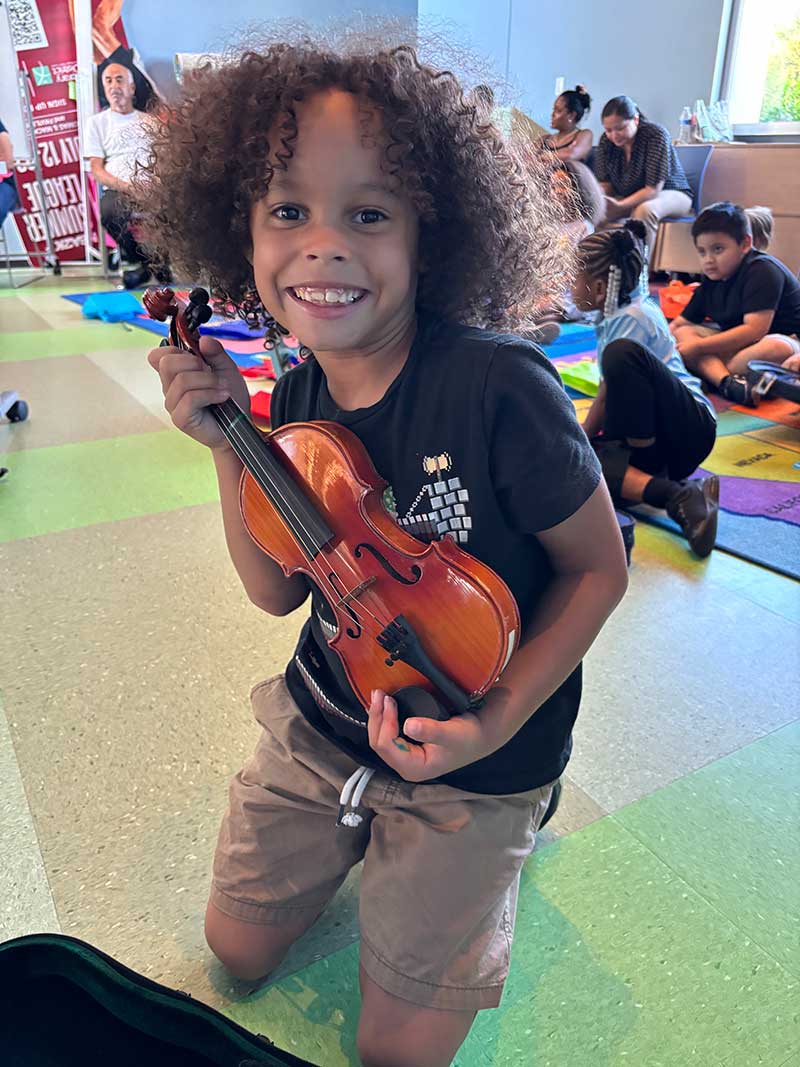
Christafer Mitchell joyfully hugs his new best friend
How to Become Part of FAYM
- Sign up for the free FAYM newsletter online at thefaym.org
- Buy a violin for a first-year student
- Help fund a collegiate scholarship for rising star musicians
- Donate space to expand FAYM’s programs in North Las Vegas and the South Valley
- Donate to FAYM’s tuition-free summer camp in June
- Donate office space to help FAYM consolidate its operation
- Donate storage space to FAYM to house its violin collection and training materials
- Underwrite a Golden Violin for advanced students
- Contribute $250 to support one year of lessons for a child
- Refer a child who would benefit from the FAYM program
Contact Information
Program & Curriculum: Tim Thomas, timthomasFAYM@gmail.com
Donations & Contributions: Hal Weller, halweller70@gmail.com
Phone (Spanish): Art Ochoa, 702-271-1742
Phone (English): Tim Thomas, 208-514-9723
For more information, visit the FAYM website at thefaym.org.
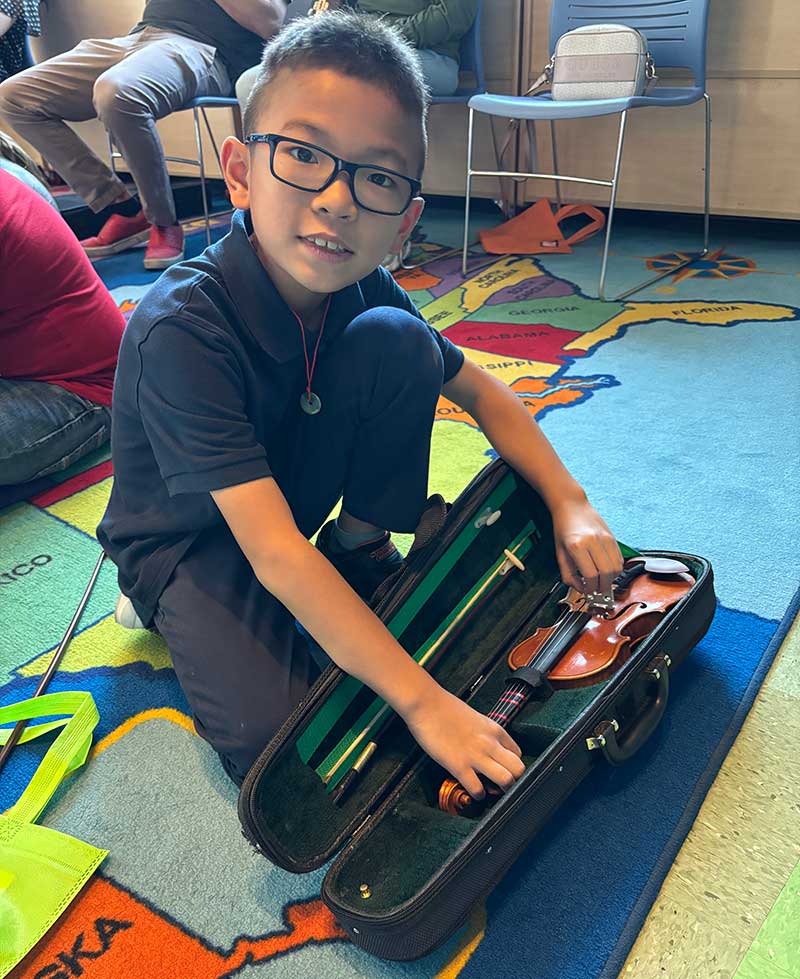
Darin Mau opened his violin case for the first time
How does music affect child development?
Music profoundly impacts child development by enhancing cognitive skills, including memory, language and problem-solving, as well as fostering social-emotional growth through emotional expression and improved interpersonal skills. Music also develops physical abilities by improving motor skills and body awareness. Incorporating music into a child’s life stimulates brain development and creates essential neural connections, setting the foundation for future learning and overall well-being.
Benefits of music on child development
- Early language development
- An increased ability to learn foreign languages
- Improved mood and emotional regulation
- Physical endurance
- Patience and discipline
- Fine motor skills, often honed through learning instruments
- What are the educational benefits of music lessons?
Learning and playing an instrument increases brain power and functionality, boosting IQ and improving concentration. Music accelerates brain development for youngsters, helping to develop:
- Participation in a group
- Enhanced social skills
- Ability to express emotions
- Enhanced self-concept by sharing music from other cultures
- Refined listening skills, noticing changes in tempo or pitch
- Creativity and imagination
- Learning new words and concepts
- Exploring cause and effect
- Improved balance, coordination and rhythm
- Improved motor skills learned by playing musical instruments
- The joy of mastering a learned skill
From “The Creative Curriculum for Preschool Children” by Diane Trister Dodge and Laura J. Colker