


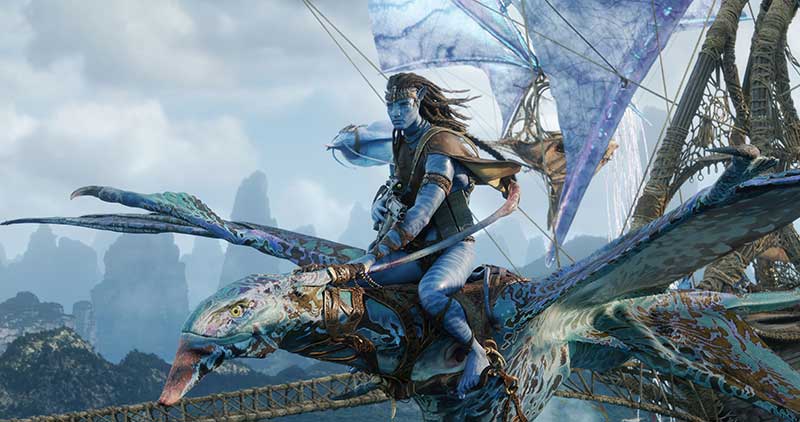
Jake Sully (Sam Worthington) in 20th Century Studios’ AVATAR: FIRE AND ASH. Photo courtesy of 20th Century Studios. © 2025 20th Century Studios. All Rights Reserved.
How Filmmaker James Cameron Continues to Create Magic with ‘Avatar: Fire and Ash’
BY JANET SUSAN R. NEPALES
Who would have imagined that a former truck driver and high school janitor would become one of Hollywood’s most successful blockbuster directors and award-winning filmmakers?
James Cameron, who taught himself about special effects by reading everything related to film technology at the University of Southern California library, quit his job as a truck driver after being inspired by watching “Star Wars” in 1977.
Now 71, the Canadian filmmaker, behind films such as “The Terminator” (1984), “Aliens” (1986), “Terminator 2: Judgment Day” (1991), “Titanic” (1997), “Avatar” (2009), “Avatar: The Way of Water” (2022), and the third installment in the “Avatar” franchise, “Avatar: Fire and Ash,” continues to pursue his passion for filmmaking and deep-sea exploration.
In this latest epic, Jake Sully (Sam Worthington) and Neytiri’s (Zoe Saldaña) family encounter a new aggressive Na’vi tribe, the Mangkwan clan — also known as the Ash People — led by the fiery Varang (Oona Chaplin).
In an exclusive interview in Beverly Hills, we spoke with the acclaimed auteur about the making of his latest film. Before I could ask my first question, Cameron surprised me by turning the tables and asking, “I am sure you have seen the other ones. So, what do you think of this film?”
“I liked it,” I replied. “It has a lot of heart. It’s very emotional for me this time.”
“I’m glad you found it emotional,” he said, quite happy with what I pointed out.
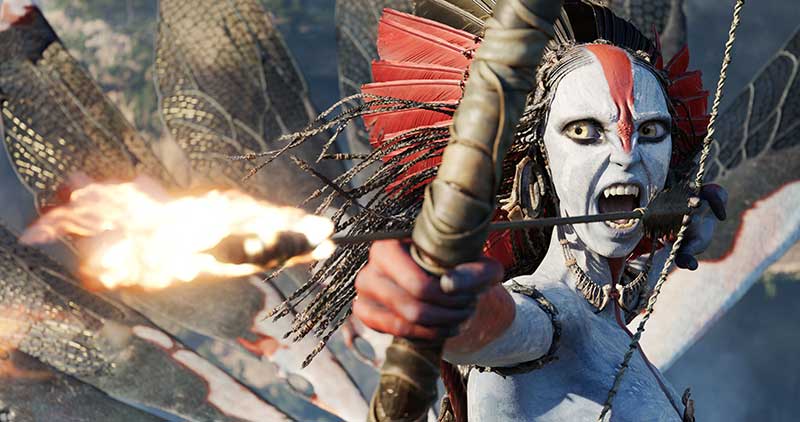
Oona Chaplin as Varang in 20th Century Studios’ AVATAR: FIRE AND ASH. Photo courtesy of 20th Century Studios. © 2025 20th Century Studios. All Rights Reserved.
So, how does he keep the story fresh, exciting and unpredictable?
“We knew we were going into uncharted territory with our characters,” Cameron said. “We knew we were going to play out the consequences of what happened in the last film, where they lost their eldest son. There are so many people around the world right now dealing with loss, fear and uncertainty. We felt it was really important to have these themes in the film and to deal with humanity.
“Obviously, our characters are blue. They’re not human, but we see ourselves in them. That’s why the ‘Avatar’ movies work everywhere. We try to deal with things people are actually facing in their lives — love, loss, relationships. The connection to community, right? The threat of war. All of these things.
“We see Jake and Neytiri and their children — Kiri and Lo’ak — going through all of this. My bet is that it connects with the heart of the audience. We promise all the visuals and the beautiful world-building, but where we really connect is in the emotions. So, I’m glad you had an emotional reaction.”
Born in Kapuskasing, Ontario, to an electrical engineer father and a nurse-artist mother, Cameron explained how emotionally charged scenes — especially those involving family and community — were among the most challenging.
“I think you can probably think of a couple of scenes that were pretty emotional for us while making the film,” he said. “Even when I was cutting it in the editing room and watching these incredible performances, there were moments that still got me. That’s how I know the film is working.”
Having worked multiple times with Worthington, Saldaña, Jack Champion (Spider), Stephen Lang (Miles Quaritch) and Sigourney Weaver (Dr. Grace Augustine), does Cameron now have a shorthand with them?
“We’re a family now,” he said proudly. “When the cast — Sam, Zoe, Jack, Stephen, Sigourney — saw the film, there were a lot of tears and hugs because we felt like we really created something together. It’s not easy. It’s hard for them. It has an easy flow because we’re doing performance capture.
“I take the cinematography and lighting out of the process. It’s just actor to actor, director to actor. It’s very immediate, almost like a theater rehearsal. It’s a very creative process, and we really enjoy it. If we get to make another one or two or whatever, we will.”
Cameron also explained the breathtaking cinematography of the scenes, whether the characters were in the air or underwater.
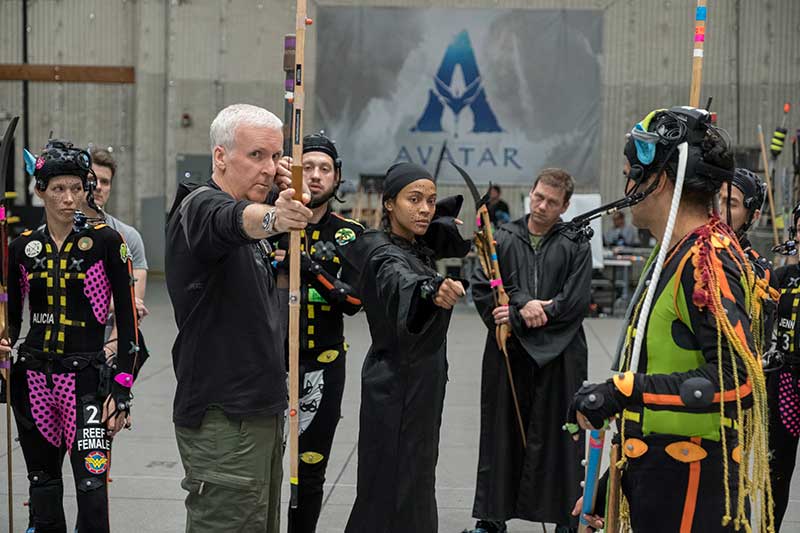
(L-R) Director James Cameron and Zoe Saldaña on the set of 20th Century Studios’ AVATAR: FIRE AND ASH. Photo by Mark Fellman. © 2024 20th Century Studios. All Rights Reserved.
“I always work closely with my cinematographer, Russell Carpenter, my director of photography,” he said. “And no matter how we try to keep the cinematographer on, he can’t stay through two or three years of post-production. So, then I have to carry those ideas and work with the ‘lighters’ — the people who light individual shots in the CG realm.
“But I try to work with Russell, and he and I go back to ‘True Lies,’ even before ‘Titanic.’ He won an Oscar for ‘Titanic,’ so I trust Russ when we talk about it to execute and to get the kind of lighting that I’m talking about. And then I keep those ideas alive myself through post-production while he’s off making other films.”
When asked if he was already working on “Avatar 4” and “Avatar 5,” Cameron was candid.
“Maybe. I’ll think about it,” he said. “The theatrical market is depressing right now. Unfortunately, people are choosing streaming over the theater-going experience. If people don’t show up, we can’t keep making films at this scale. And then we’ll have to adjust, and I’ll tell other stories. Hopefully, people understand that this movie completes a story — it’s a two-part story between ‘The Way of Water’ and ‘Fire and Ash.’ If we go on, I already know what those stories are, but they’re different.”
We pointed out to Cameron that this latest installment feels more relevant to our times because it reflects the plight of people facing hate, mistrust and displacement, particularly refugees and immigrants.
“The Sullys are displaced by violence. Jake Sully leaves to keep his people, his forest people, safe. But it doesn’t matter. The enemy is chasing him. They’re looking for him. They’re not going to mess with the Omatikaya if they don’t need to, and they’re looking for Neytiri. They’re looking for his family. He has a very specific reason to leave. But anyone who has been displaced from their home is going to find it emotionally traumatic.
“And that’s why we see Neytiri early in the film say, ‘I don’t have my forest. I don’t have people whom I grew up with.’ She feels like a stranger in a strange land. She’s not a water person. And the fun thing is that Zoe Saldaña herself is not a water person. She’s actually like a cat. Now, she has learned how to hold her breath and be underwater, and she looks very comfortable in the movie, but it’s not her thing.
“We’re dealing with this idea of where do I belong, where’s my home? Once I’ve found the place where I want to belong, I have to earn that. I have to earn the respect and acceptance of those people. We also see that with Spider. Spider desperately wants to be Na’vi. He appreciates them so much. He paints himself blue. He tries to be Na’vi.
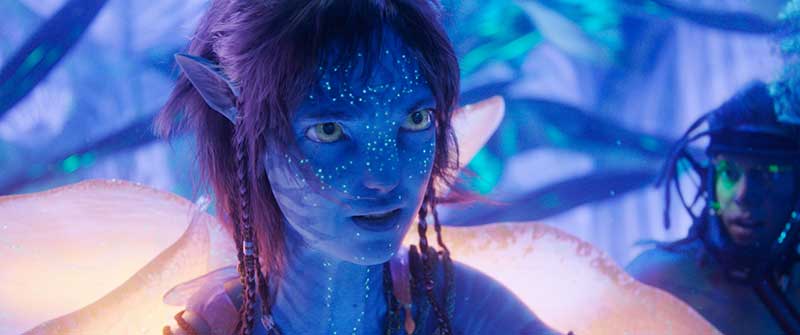
Kiri (Sigourney Weaver) in 20th Century Studios’ AVATAR: FIRE AND ASH. Photo courtesy of 20th Century Studios. © 2025 20th Century Studios. All Rights Reserved.
“He tries to be part of the Sully family. Neytiri’s not having it because she’s gone to a very dark place. But Spider is accepted by the next generation, by the kids. We see that hatred sometimes stops with the next generation, or at least it has to be learned all over again.
“He feels like an outsider even in his own family at times. That sense of displacement, or not knowing where you belong, who you are, or having a sense of self-worth, is something you see a lot with young people today. I grew up in troubled times in the ’60s, and I remember my teenage years as being troubled. We’re dealing with a lot of pressure on this family. They’re displaced. Do they fit in? They’re trying to earn their place with the Reef People.
“They’re mixed-race kids. Everybody knows Jake is part human, and that tension exists in the marriage. You think after the first movie, oh, it’s an amazing love story. These people are going to be in love for the rest of their lives. Then you have kids. Stress number one. Now you’re at war, and you’re a mixed-race family living in a new place, trying to fit in and be respected and seen by that culture.
“I throw a lot of obstacles in the path of the Sullys, and I think that puts the audience on their side. We want to see them succeed. We want to go on that journey. Now you start throwing real serious threats at them, like the Ash People, like the humans who are coming to harvest the Tulkun that threatens the entire community. Once again, in that allegorical way, it’s dealing with a lot of things that people are going through right now in a way that seems to be full of hate than I can remember in my lifetime.”
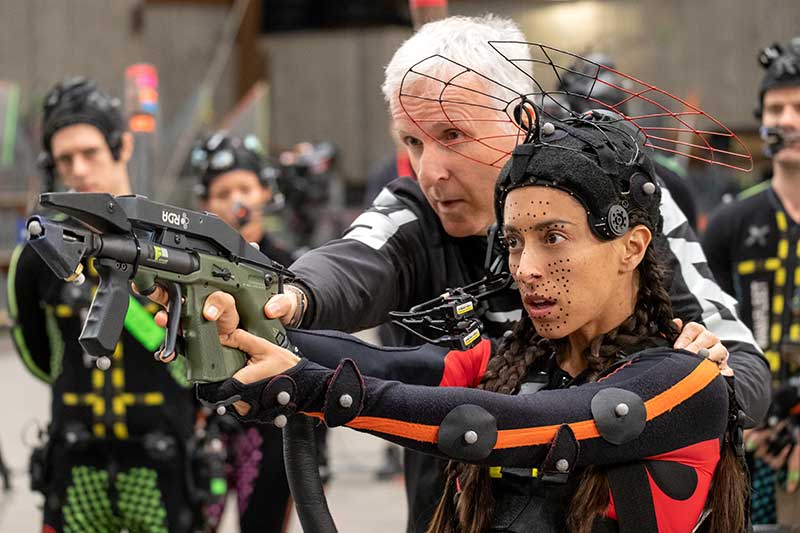
Director James Cameron and Oona Chaplin on the set of 20th Century Studios’ AVATAR: FIRE AND ASH. Photo by Mark Fellman. © 2025 20th Century Studios. All Rights Reserved.
Miley Cyrus on Working on the Song for “Avatar: Fire and Ash”
In a separate interview at the Four Seasons Hotel Los Angeles at Beverly Hills, pop superstar Miley Cyrus spoke about creating the song “Dream as One” for the film.
“I had to watch the film first, and it wasn’t finished yet,” said the 33-year-old singer-composer.
“What I loved about that was it made it feel more a part of the ‘Avatar’ family, as someone new coming in after they’ve been working on this for 15 years, which was genius on my part. I’m starting to do the whole thing that everyone else is doing, with not even two percent of the hard work that it takes to do this. But it made me feel much more like a part of the entire journey they go on as creators.
“But I could obviously see myself in the story, which is what I love about ‘Avatar.’ It’s large-scale, but it still has an intimacy and emotion that makes you feel like you can identify with the story, even though we don’t all live in Pandora. In some way, we all create our own kind of clans and that kind of chosen family, and resilience is something that resonated with me a lot for the song.”
Cyrus explained to us which themes from the movie – fire and ashes of human relationships, grief, loss and family dynamics – she would want the melody and lyrics to reflect on.
“Well, the melody, for me, I wanted something that surrendered to the scale of the film,” she said. And even though it belts and it grows, and it gets big, it starts as a singular vocal, very minimal, which I thought was very anti-‘Avatar.'”
She added, “I like to do anti-things. Whatever you’re supposed to do, I want to do the other thing. I started it as small as I could, knowing that it could always grow. ‘Avatar’ is more than epic, and I really realized that at the premiere, more so than I did in my first couple of viewings. Because even though it’s over the top and the sound design is incredible, and you’re immersed immediately, I saw the smaller moments as something that really stood out to me in ‘Fire and Ash.’
“I wanted my song to have small, intimate, quiet family moments but be very glamorous as well. Because when I think of ‘Avatar,’ especially costume designer Deborah Scott’s work with everything she does in the costume design, I love all the looks. That was one of my favorite parts. And I love that everyone has their own identity. Even though they’re a clan, they’re a group, they still individualize themselves. I was really inspired by the incredibly beautiful world that James created.”
Leave A Comment