


Designer: David Tupaz; Photography: Jaime Lim; Model: Tiffany Chang
Soft Power, Loud Heart:
Tiffany Chang on Identity, Resilience and Redefining Leadership
By Laura Henkel
Tiffany Chang is not your typical changemaker. She is something far rarer. A Stanford student, nonprofit founder and crowned Miss Asia USA, Chang is the kind of leader who navigates high-pressure spaces with both poise and purpose. But beyond the accolades lies a story of quiet grit, cultural duality and a deep commitment to creating meaningful impact.
In this wide-ranging, intimate Q&A, Chang opens up about what it costs to live between worlds and what it takes to lead from them. She speaks candidly about moments of doubt, the unseen labor behind her successes and the power of softness in spaces that often demand perfection. Through her words, we see not just a role model, but a real person: someone who is still becoming, still questioning and still choosing to show up fully, even when it’s hard.
For anyone who has ever felt like they had to split themselves to fit in, Chang offers a different model: one built on wholeness, empathy and redefining success on your own terms.
ORIGIN & INFLUENCE
Chic Compass: Who did you look up to as a child, and what parts of them do you now see in yourself?
Tiffany Chang: Growing up, I looked up to two incredible women: my mom and my ama (grandma). My mom is like superwoman. She runs her own business, works full time and yet somehow never misses a moment, whether it’s a school event, a late-night pageant rehearsal or just being there when I need her most. She’s the most selfless person I know, and I’ve inherited her drive and deep sense of responsibility to show up fully for the people I care about.
My ama is the matriarch of our family. Every day after school, I’d go to her house, and she became my moral compass. She taught me the values I carry with me today—kindness, perseverance, humility and resilience—often through the simplest moments: playing puzzles, teaching me how to read or just talking about life. She gave me the heart behind everything I do.
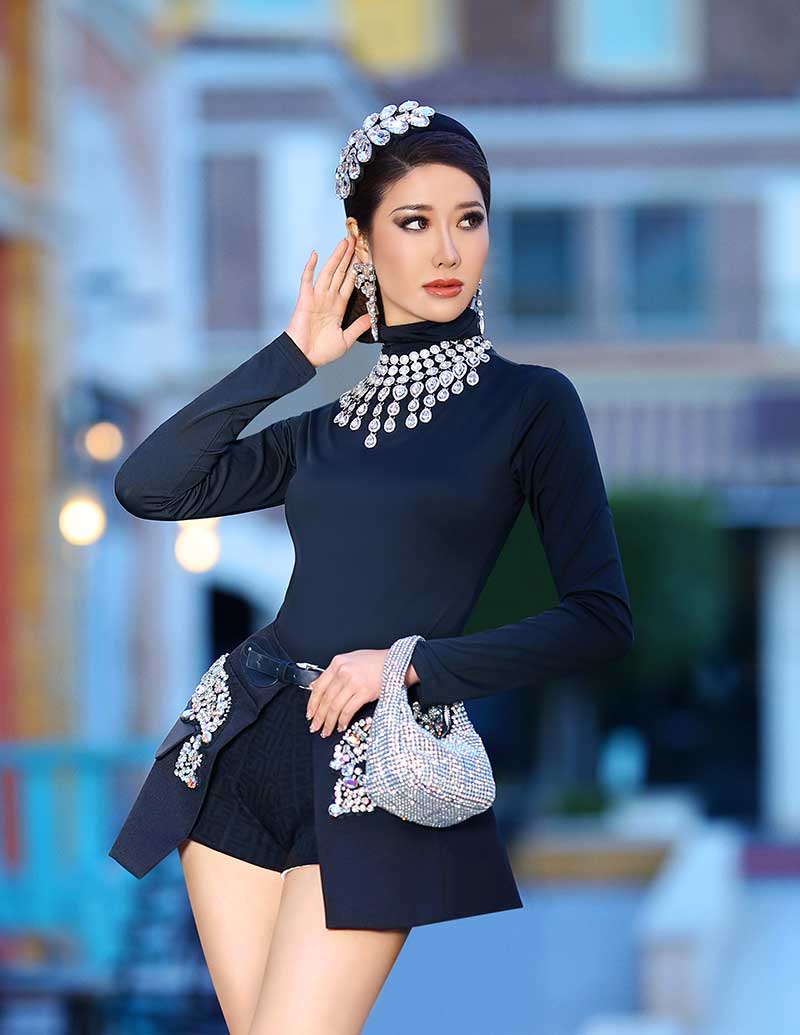
Designer: David Tupaz; Photography: Jaime Lim; Model: Tiffany Chang
Chic Compass: When did you first realize you were living in two worlds, and what did it cost you to exist between them?
Tiffany Chang: I realized I was living in two worlds the moment something I treasured—my culture—became a source of shame in someone else’s eyes. After I proudly played the Chinese zither, a classmate scoffed, “Are you going to wear that embarrassing oriental costume and play that weird instrument again?” I remember feeling a rush of humiliation, anger and confusion, but mostly, I felt small. I couldn’t find the voice to defend myself. That silence echoed the same feeling I had in English class, where I felt like every discussion was a test of worth, not a place to be heard. I wanted to speak, but self-doubt kept pulling me back, like pressing the gas and brake at the same time.
These experiences made me question: Would I ever be enough? Living in between meant constantly translating not just language but value. It cost me my voice for a while. But reclaiming that voice, through public speaking, advocacy and redefining what it means to be both Asian and American, has been the most powerful part of my journey.
Even in the spaces they didn’t fully grasp, they believed in me. And that belief became my foundation.
TRANSFORMATION & RESILIENCE
Chic Compass: What’s a moment you wanted to quit but didn’t? What did it teach you about grit, grace or even surrender?
Tiffany Chang: There was a moment during the Miss Asia USA competition when I seriously questioned if I belonged. Behind the glamour, I was battling imposter syndrome, comparing myself to women who seemed so effortlessly confident, polished and perfect. I remember standing backstage, crown slipping, lashes half-off, thinking—what am I doing here? I felt small, messy and not enough.
But instead of quitting, I paused. I reminded myself that I wasn’t there to be perfect—I was there to be real. To show the little girls watching, especially Asian girls, that representation doesn’t require perfection. I walked back onstage, heart pounding but grounded in something deeper than nerves: purpose.
That moment taught me that grit isn’t always loud. Sometimes it’s quiet. It’s continuing to show up when every part of you wants to shrink. It’s grace, allowing yourself to feel the fear and do it anyway. And it’s surrender, not to failure, but to the truth that you’re allowed to take up space even before you feel “ready.”
Chic Compass: You navigate extreme expectations across cultural, academic, visual and emotional realms. Where do you go to feel fully human?
Tiffany Chang: I feel most fully human in the quiet in-betweens, like coming back home from school, spending time with my family and laughing over inside jokes with my sister. It’s not on the stage or in the spotlight, but in the small, ordinary moments where no one’s watching and I’m not performing. That’s where I can exhale.
I also find grounding in the places that raised me, especially my grandma’s home. I find the most zen in the presence of my grandma. There’s something about the way she moves through the world—slow, intentional, steady—that reminds me to breathe. In that space, I don’t have to excel or impress, I just have to be present.
When the expectations feel loud, when I’m balancing academic pressure, cultural identity, pageant presentation and everything in between, I go back to those roots. The moments that remind me that before the crown, the resume or the title, I was already enough.
Chic Compass: If perfection was no longer the price of admission, how would you show up differently in pageantry, at Stanford or in life?
Tiffany Chang: I’d let people see the messy middle more often—the part where I don’t have it all figured out, where the crown tilts or I trip over my words in class. I think so much of my life has been shaped by the pressure to prove I’m worthy: the perfect student, the perfect spokesperson, the perfect daughter balancing two cultures. But in chasing perfection, I sometimes left little room for grace.
Without that pressure, I’d show up with more softness. I’d ask more questions instead of always trying to have the right answers. I’d be less afraid to raise my hand in a lecture or walk onstage without every detail being polished. I’d let myself take up space as I am, not just when I feel like I’ve “earned” it.
Because at the end of the day, the most powerful version of me isn’t the perfect one—it’s the honest one.
VALUES, PURPOSE & UNSEEN LABOR
Chic Compass: Your résumé is impressive. But what’s the hardest thing you do that no one claps for?
Tiffany Chang: The hardest thing I do, the thing no one sees or claps for, is learning how to be kind to myself when I fall short. It’s picking myself up after a rejection, a bad day or a quiet breakdown, and choosing to keep showing up anyway. It’s rewriting the voice in my head that says I’m not doing enough, not being enough.
There’s no applause for the nights I sit with self-doubt and still choose to believe in the bigger picture. No trophies for staying grounded when comparison creeps in. No spotlight on the quiet work of healing generational expectations or navigating spaces that weren’t built with people like me in mind.
But that inner work—the work of unlearning, softening and forgiving—is what makes everything else possible. It’s what lets me lead with empathy, perform with heart and pursue big dreams without losing myself in the process.

Designer: David Tupaz; Photography: Jaime Lim; Model: Tiffany Chang
Chic Compass: When you think about success, whose definition are you using, and how has that evolved?
Tiffany Chang: For a long time, I chased a definition of success that wasn’t mine. It was a mosaic built from my family’s sacrifices, cultural expectations and society’s highlight reels—good grades, prestigious schools, picture-perfect achievements. I thought success meant being chosen: winning the award, getting the title, being told I was enough.
But over time, especially through moments of burnout, self-doubt and quiet victories, I’ve started rewriting that definition. Success, to me now, is about alignment. It’s not about how many people clap for you, it’s about whether you’re proud of who you are when no one’s watching. It’s the courage to build a life that reflects your values, even if it doesn’t look like anyone else’s blueprint.
Today, I define success as living with integrity, showing up with heart and leaving spaces more inclusive and inspired than I found them. And that version feels a lot more like me.
Chic Compass: Share a belief you hold that might make others uncomfortable, yet remains undeniably true for you.
Tiffany Chang: I believe that softness is a form of strength and that femininity and leadership are not opposites. In a world that often celebrates loudness, dominance and hustle, I’ve found that my greatest impact comes from empathy, vulnerability and emotional intelligence.
Some people see compassion as weakness or pageantry as superficial. But I’ve seen firsthand how storytelling, cultural pride and even a crown can be powerful tools for change. I don’t believe I need to shed my softness to be taken seriously—I believe I can lead with it.
It might make some people uncomfortable to rethink what power looks like. But for me, it looks like using my voice to make space for others. And it feels like knowing that being fully, unapologetically myself is the most powerful thing I can do.
Chic Compass: What are you currently unlearning?
Tiffany Chang: I’m currently unlearning the idea that I have to earn rest. For so long, I equated productivity with worth, like every minute not spent achieving was a minute wasted. Especially as a woman of color in high-achieving spaces, I felt this constant pressure to prove myself, to justify every opportunity I received.
But I’m learning that rest isn’t a reward, it’s a requirement. That I don’t have to hustle to deserve peace or dim my needs to stay palatable. I’m unlearning the myth that vulnerability makes me less capable and instead realizing it makes me more human, more grounded, more whole.
And maybe most importantly, I’m unlearning the belief that I need to fit into existing definitions of leadership, success or womanhood. I’m building new ones on my own terms.
Chic Compass: What problem in the world keeps you up at night, not because you’re expected to care but because you genuinely do?
Tiffany Chang: The problem that keeps me up at night is how many people feel unseen in their pain. Especially in a world that’s constantly online, we’ve become good at curating highlight reels—showing the picture-perfect parts of our lives—and bad at checking in with what’s underneath. I think about the quiet battles people face: the student who looks put together but is falling apart inside, the immigrant parent who never talks about their stress, the teen who jokes to mask anxiety.
I care about mental health not because it’s trendy to talk about it, but because I’ve lived it. I’ve seen what it’s like to push through panic attacks in silence, to feel like you have to be “on” even when you’re unraveling. And I care deeply about building a world where people don’t feel like they have to earn their pain or hide it.
It keeps me up at night that so many people feel like they’re suffering alone. And it drives me to keep creating spaces—online, in my nonprofit, through storytelling—where being vulnerable is not only allowed but honored.
CREATION & INTELLECTUAL CURIOSITY
Chic Compass: Stanford is known for innovation. What’s one idea or experiment you’re obsessed with right now?
Tiffany Chang: I’m currently obsessed with reimagining innovation through the lens of human-centered design. So much of the tech world is driven by what’s technically possible, but I’m far more interested in what’s personally meaningful. At Stanford, I’ve been exploring how we can design solutions that don’t just work, but truly work for people, especially those who are often overlooked.
One idea I’m exploring is how we can integrate principles of human-centered design into AI and sustainability. For example, how might we create edge AI tools that support elder care not just efficiently but empathetically? Or rethink product design for accessibility not just as an afterthought but from the very beginning?
To me, innovation isn’t just about inventing new things. It’s about deeply listening, noticing what people need and building with heart. I want to create tools, systems and experiences that don’t just impress users but empower them.

Designer: David Tupaz; Photography: Jaime Lim; Model: Tiffany Chang
CULTURE, COMMUNITY & CONNECTION
Chic Compass: How do you stay connected to your culture in a world that often tries to flatten it into a buzzword or trend?
Tiffany Chang: I stay connected to my culture by returning to the people, rituals and stories that shaped me, not the polished version you see on social media, but the lived, everyday beauty of it. It’s in the way my ama (grandma) arms wrap around me whenever I come back home, the smell of lu rou fan simmering on the stove and the moments when we speak Taiwanese at home in between generations. It’s in the small decisions, offering food before taking it, choosing humility over recognition, that carry the values I grew up with. Culture lives in those details, not in grand gestures, and that’s where I find my deepest sense of belonging.
I also stay grounded by always showing up for and supporting my community, attending Taiwanese and Asian cultural events, creating content for awareness, volunteering, supporting local organizers and uplifting others who share pieces of my story. These aren’t just events, they’re living threads that keep our heritage alive and evolving.
In a world that often reduces culture to an aesthetic or hashtag, I remind myself that culture is not content. It’s not something to perform, it’s something to protect, to live, to pass on. I stay rooted by researching my heritage and using my platforms, whether in pageantry, tech or storytelling, to celebrate it with depth, not decoration.
Representation isn’t just about being seen. It’s about being understood. And staying connected to my culture means choosing depth over display every time.
Chic Compass: What does sisterhood mean to you, and where have you found it most unexpectedly?
Tiffany Chang: To me, sisterhood is about showing up, not just when it’s convenient, but when it’s hard. It’s the kind of bond that says, I see you, even when the world doesn’t. It means holding space for someone else’s growth, cheering loudly for their wins and sitting quietly with them through their lows. Sisterhood is not just shared identity, it’s shared intention.
I’ve found sisterhood most unexpectedly in pageantry. From the outside, it might seem competitive or surface-level, but behind the scenes, I’ve met some of the most generous, vulnerable and supportive women. Women who help zip up your dress before going onstage, fix your lashes when you’re too nervous to breathe, and remind you who you are when self-doubt creeps in. That solidarity, among women who are often judged or underestimated, has been one of the most powerful reminders that sisterhood can thrive even in the most unexpected spaces.
PHILANTHROPY & MISSION-DRIVEN WORK
Chic Compass: What was the moment that inspired Madhatter Knits, and how has that mission changed you as much as it’s helped others?
Tiffany Chang: Madhatter Knits began when I was in the 6th grade and I knitted a small hat. At the time, my cousin was volunteering at the San Gabriel Valley Medical Center and had just visited the NICU. We realized these beanies were the perfect size for a preemie’s head, fighting for their very first breath, especially since a lot of their warmth escapes through their head, making it difficult for them to keep their body temperatures stable. We started with our first donation of 160 knit hats during Christmas of 2014 to the Children’s Hospital Los Angeles. With the mission to give preemies and their families love, warmth and support, Madhatter Knits was born.
What started as a simple gesture grew into a global movement. We’ve now donated millions of handmade hats around the world and grown immensely with international chapters, but what’s changed me most isn’t the scale; it’s the stories. It’s the moms who write to us saying the beanie helped her feel like her baby wasn’t just a patient, but a person. It’s the volunteers who found healing in creating something with their hands.
Madhatter Knits taught me that impact doesn’t always start with strategy, it starts with heart. It showed me that leadership isn’t about having all the answers; it’s about inviting others into the solution. And it reminded me that care is a powerful form of resistance, especially in a world that often moves too fast to notice the smallest ones among us.
Chic Compass: What do you hope Madhatter Knits, or any future project you start, represents in the bigger picture of how young people can make a meaningful impact?
Tiffany Chang: I hope Madhatter Knits shows that you don’t need to have a title, a budget or years of experience to start something that matters. You just need heart, a clear “why” and the courage to begin. We started with four people and an idea that felt too small to be world-changing…until it wasn’t.
In the bigger picture, I want Madhatter Knits to represent what’s possible when young people stop waiting for permission and start building from empathy. I hope it reminds others that “impact” isn’t reserved for people in boardrooms or on big stages. It starts in everyday decisions, small acts of care and the willingness to solve problems you care about.
Whether it’s a beanie, a business or a movement, I want young people to know that their lived experiences are valid blueprints for change. If our work can empower others to believe that they, too, are capable of meaningful impact, then we’ve done more than knit hats. We’ve stitched together a ripple effect of possibility.

Designer: David Tupaz; Photography: Jaime Lim; Model: Tiffany Chang
MOMENTUM & VISION
Chic Compass: What does power look like to you when no one is watching?
Tiffany Chang: Power, when no one is watching, looks like integrity. It’s how you treat people who can’t do anything for you. It’s the choice to do the right thing, even when it’s inconvenient, unrecognized or uncomfortable.
To me, real power is quiet. It’s found in the discipline of showing up for your commitments when no one’s holding you accountable. It’s in the care you give to your community without expecting applause. It’s in staying grounded in your values when the spotlight’s gone and the crown is off.
It also looks like self-compassion, the ability to be kind to yourself on the days you don’t feel strong. Because if you can lead yourself with grace, you can lead others with empathy. Power isn’t just about influence, it’s about consistency, character and choosing love over ego.
Chic Compass: What’s something you’ve never said in an interview before, but feel safe enough to share now?
Tiffany Chang: Sometimes I feel lonely in the rooms I once dreamed of being in. From pageant stages to Stanford classrooms to boardrooms full of opportunity, I’ve found myself surrounded by people, applause and momentum…yet still feeling like I’m carrying something no one else sees. The pressure to keep achieving, to keep representing, to keep holding it all together, it doesn’t always leave space to just be.
I think there’s a version of me that people see, polished, high-performing, always “on.” But the truth is, I still have to remind myself it’s okay to rest. It’s okay to not always be strong. And it’s okay to say “I’m struggling” without feeling like I’m letting someone down.
What I’ve learned is that vulnerability isn’t something to outgrow. It’s something to grow into. And I’m learning to find power not just in what I accomplish, but in being honest about what it takes to get there.
Chic Compass: If your story was a manifesto, what would the title be, and what’s the first line?
Tiffany Chang: Title: “Soft Power, Loud Heart”
First line: They tried to measure me by how well I fit, but I was never meant to fit; I was meant to reshape the space.
Chic Compass: Imagine this article becomes a time capsule. What would you want 80-year-old Tiffany to remember about the version of you today?
Tiffany Chang: I’d want 80-year-old me to remember how hard I tried, not just to succeed, but to stay true. That even when I was unsure, I kept showing up with heart. That I was learning how to be bold without being hardened, ambitious without losing softness, and proud without letting ego take the wheel.
I’d want her to remember the late nights filled with self-doubt, the small wins no one saw, the courage it took to speak up even when my voice shook. And most of all, I’d want her to remember that this version of me loved deeply, my family, my community, my culture—and built from that love, not in spite of it.
Because at the end of the day, titles fade, applause quiets, but the why behind it all, that’s what I hope she never forgets.