


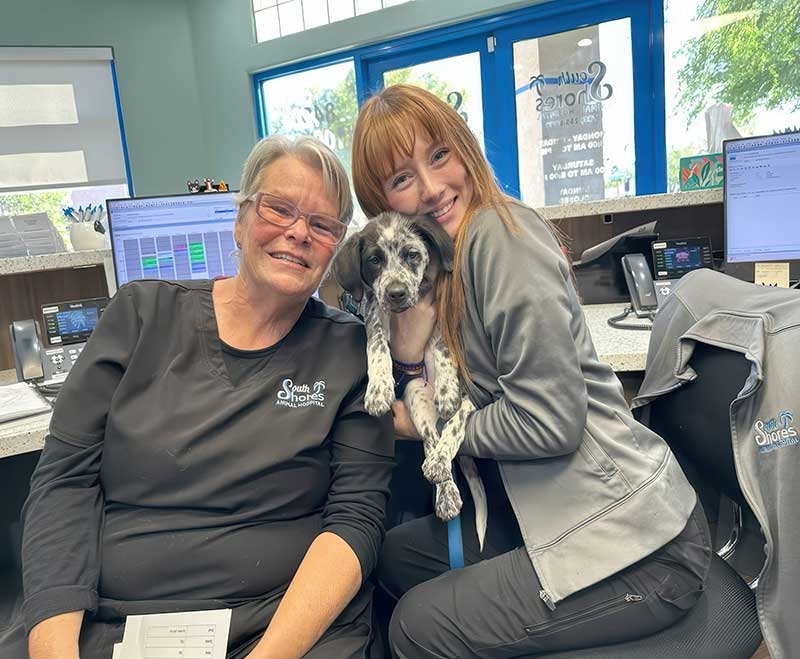
Dawna and Hallie are two of the friendliest staff at South Shores Animal Hospital, and the entire team is fantastic
Grace, Practiced Daily
BY LAURA HENKEL / PHOTOGRAPHY COURTESY OF SOUTH SHORES ANIMAL HOSPITAL
Grace does not arrive cleanly. It does not announce itself or ask permission. It rarely looks like virtue when it first appears. More often, grace shows up hungry, frightened, inconvenient — trailing behind you on a walk, perched on borrowed wings or waiting quietly to see whether you will notice at all.
I did not set out to write about animals. I set out to understand grace — not as an abstract idea, but as a practice. Grace is a word we often reserve for belief systems or moral aspirations, for moments we imagine should feel elevated or resolved. But lived grace is rarely tidy. It is logistical. It is repetitive. It is choosing, again and again, to remain present when withdrawal would be easier.
Over the past two decades, animals have moved through every chapter of my adult life, often arriving without invitation and staying long enough to alter my understanding of care, responsibility and loss. They asked for attention when I was tired, for patience when I wanted efficiency and for courage when letting go felt unbearable.
Again and again, it was through animals — furry, feathery, overlooked and unwanted — that grace found me, tested me and reshaped my life.
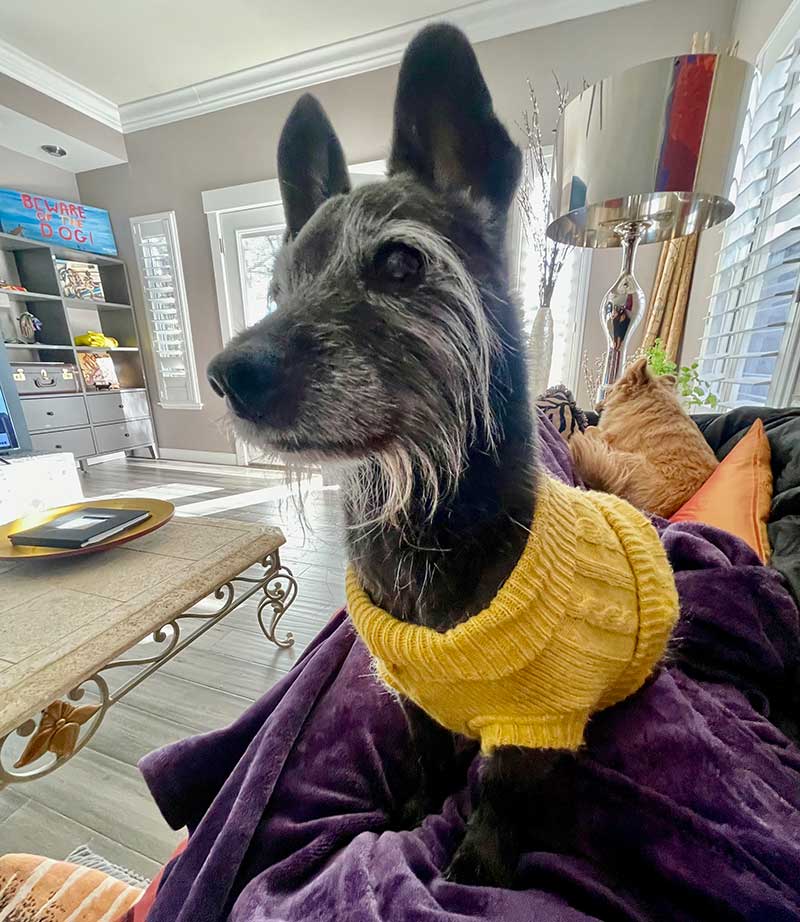
Trouble (front) and Nick (back) both chose their human
It was only later, through my relationship with Dr. Karen Stasiak, a veterinarian at South Shores Animal Hospital, that I came to recognize what I had been practicing all along. Through her clinical work with aging, traumatized and neglected animals, she gave language to patterns I had lived for decades but never formally named.
Animals, she explained, do not communicate distress through drama. They speak first through subtle shifts — the eyes, the posture, the willingness or reluctance to engage. "People often miss the early signals," she told me. "But animals are always telling us how they are doing. We just have to slow down enough to listen."
I had learned to listen long before I knew why.
Grace, I came to understand, is not sentiment.
It is practice.
Portia: Freedom Without Confinement
After my divorce, when I was living in Dallas and learning how to inhabit my own life again, I bought a budgie and a cage for $20. It seemed like a reasonable decision — small, manageable, contained. Something that would not ask too much of me.
But the moment I brought her home, the cage felt wrong. Not cruel exactly, but insufficient. Too small for a creature so alert to the world.
So I made a decision. The house would become her cage.
I created landing points throughout the space and learned to live differently — mindful of doors, windows, timing. Freedom, I learned quickly, is not the absence of structure. It is responsibility practiced with attention.
Her name was Portia. She was sweet, observant and opinionated. When I began dating again and grew serious with one man, Portia made her assessment immediately. She dive-bombed him relentlessly, a tiny yellow avian missile asserting her authority. It was impossible not to laugh.
Eventually, something shifted. Trust, once earned, was wholehearted. She perched on his shoulder, gave kisses and became part of our shared rituals. Every morning, she waited patiently outside the shower. The moment we stepped out, she flew to our shoulders, ready for her own splash of water. She rode our toothbrushes like a bull at a rodeo as we brushed our teeth. She was the belle of our dinner parties — curious, impeccably behaved, beginning to speak.
What surprised me most was how much personality emerged once she was allowed to fully participate. She expressed affection, anger, jealousy, curiosity, playfulness — preference. She did not simply exist in the house; she engaged with it and with us. That kind of complexity does not emerge from confinement. It develops when a being is allowed to participate fully in its environment. Had she remained caged — fed, watered and observed — she might have survived. Instead, she lived.
And then one day, a bulge on her tiny stomach. A tumor.
That $20 bird ultimately cost far more than money as we sought help from an avian specialist. We did not hesitate. Love does not tally costs once commitment has been made.
When it became clear we had reached the end, we were grief-stricken. We buried her in the garden beside a newly planted honeysuckle. Over time, hummingbirds and bees arrived in abundance. To this day, whenever I see either, I think of Portia.
Because of Portia, I came to believe that every animal has the right — the freedom — to flourish.
Grace, I learned, does not disappear when life ends.
It lingers.
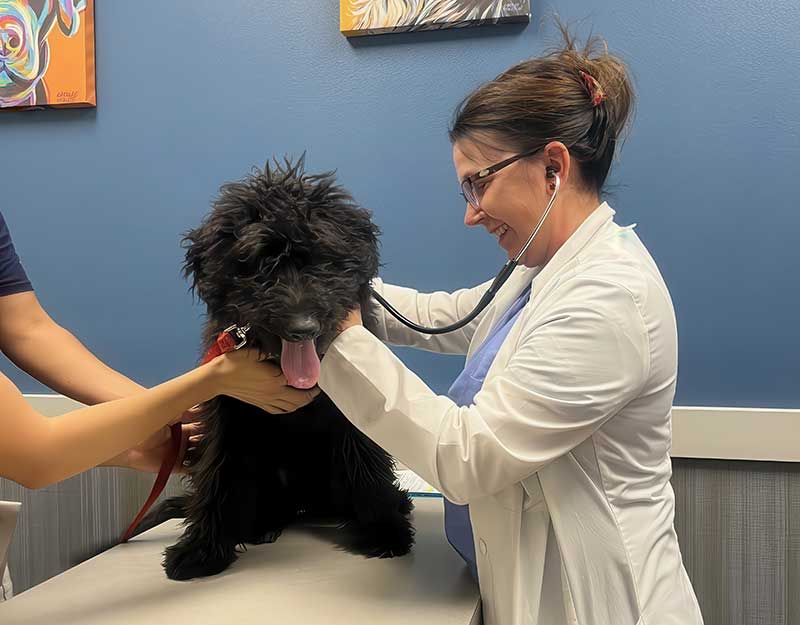
Dr. Karen Stasiak is at work, in tune with her patients and their companions
Chocolate Chip: Loyalty Without Negotiation
After Dallas came San Francisco — and with it, Chocolate Chip.
She was a rescued bait dog from Oakland, a German shepherd-corgi mix improbably assembled and utterly resilient. She had the body of a shepherd, the legs of a corgi and a face that seemed to hold two expressions at once. When she ran, she looked almost aerodynamic. When she was happy, one ear stood straight up while the other flopped downward, joy disrupting symmetry. She smiled, too.
Chip did not like people. I learned to respect that. I kept her close. We kept our distance. But my closest friends — those who moved slowly and listened— earned her trust. And once she loved you, she loved you completely.
By the time she was a year and a half old, it became clear that something was wrong physically with her configuration. What followed was a double TPLO surgery at a leading veterinary teaching hospital. She emerged bionic — stronger, steadier, unmistakably herself again.
During her recovery, care, almost without noticing, became a ritual. Chip loved curries, barbecue — whatever came from the kitchen. Food, I learned, was not just nourishment. It was conversation.
We eventually found our way to Sausalito. I bought a sailboat to live on and put my house in storage. The boat was ready to set sail within 15 minutes. Chip adored boat life. She sunbathed on deck, leapt into the bay for swims and took to the rhythms of tide and wind as if she had always belonged there. Noise could still startle her — likely remnants of her early life — but trauma did not define her. She flourished anyway.
I never once locked the boat.
There is a particular kind of safety that comes from openness — from leaving the hatch open at night, from trusting the water and the wind, from moving through the world without barricades. Chip understood this instinctively. She knew I was her protector and she was mine. We watched over one another. On the boat, in the Marin Headlands, on long hikes along the cliffs and beaches, we moved as a unit — alert, attuned, unafraid. We both felt safe.
I had Chip for 15 years. Fifteen years is long enough to watch yourself change. Long enough to move cities, lose relationships, rebuild routines and discover which parts of yourself persist. Chip witnessed all of it — steadily, without condition.
Toward the end, she looked at me with unmistakable clarity. Her eyes lost their sparkle. She told me she was ready.
Letting her go was hard — truly hard — but I listened. I did not prolong anything to soothe my own grief. I made her last day gentle, familiar, easy.
Love, I learned, is not holding on.
Zeus: Dignity Without Containment
Zeus had not always looked the way he did at the end.
In his youth, he suffered from mange and lost much of the hair on his back. It never fully returned. He lived alert and itinerant, always moving — outwitting the dog catcher, navigating the Sausalito waterfront with practiced intelligence. Left to his own devices, he survived through agility and endurance.
He was Tramp incarnate. Wise. Unowned. Choosing.
Zeus was a blue heeler-labrador mix, a Labraheeler. His alertness and endurance were shaped as much by instinct as by years spent surviving the docks. When Chip and I lived on a boat in Sausalito, Zeus entered our lives without announcement. He and Chip became companions — quiet, watchful, deeply aligned. He came and went as he pleased, as if the boat were simply another piece of the waterfront. At night, he chose to sleep with us, tucked under warm covers.
When it came time to leave Sausalito for Las Vegas, I hesitated. Zeus belonged to fog and pilings and salt air. But the local veterinarian urged me to bring him.
He understood something I did not yet know.
In Las Vegas, Zeus did something extraordinary. He rested.
For the first time, he relaxed. He barked. He discovered bones, hid them, reclaimed them. He took midnight swims. And slowly — astonishingly — his hair grew back fully.
The body, it turns out, remembers safety.
Zeus later developed acute kidney failure. The doctors did not know how he was still standing. I brought him in because something was off — subtle, but unmistakable. Animals do not dramatize decline. They communicate it.
I planned his last day.
There was a walk. A steak. A swim. Lounging. The veterinarian came to the house.
I often wish we treated people this well when their time comes — offering dignity instead of prolonged misery, presence instead of avoidance. Zeus was not made to linger.
After he died, I brought his ashes back to Sausalito. The waterfront people — those who had known him from puppyhood onward — gathered. One by one, they scattered his ashes into the bay, telling stories.
Zeus, it turned out, had belonged to many of us.
Grace, Zeus taught me, is not about saving a life at all costs. It is about honoring a life completely.
Trouble: Safety Repeated Until the Body Believes
Trouble came into my life with Chip when he was about a year old in downtown Las Vegas — malnourished, scruffy, so underfed that a friend once joked he looked like a dog in a rat costume. He was a schnauzer-Jack Russell mix, all sharp edges and watchfulness.
I named him Trouble after he ate every fitted sheet I owned. Not shoes. Not furniture. Just sheets.
From puppyhood until the day he died, Trouble would occasionally cower when I reached to pat his head. Someone had done a number on him. The history lived in his body.
With Trouble, you either got bit or you got kisses. If you got kisses, you knew you were special. If you got bit, you were special too — you usually tried to win him over, learning eventually that respect mattered more than persistence.
And yet, he knew he was safe.
As he aged, something else happened. With safety came softness. With trust came beauty. He began to prance when he walked. When he wanted something, he struck a perfect meerkat pose — upright, paws tucked, big brown eyes impossibly earnest. Silver wisps crept into his coat, giving him a kind of quiet distinction. He became, improbably, handsome — the Sean Connery of mutts.
Trauma does not disappear through reassurance alone. It softens through repetition — through day after day of nothing bad happening.
Grace, Trouble taught me, is not the absence of fear.
It is safety repeated until the body believes it.
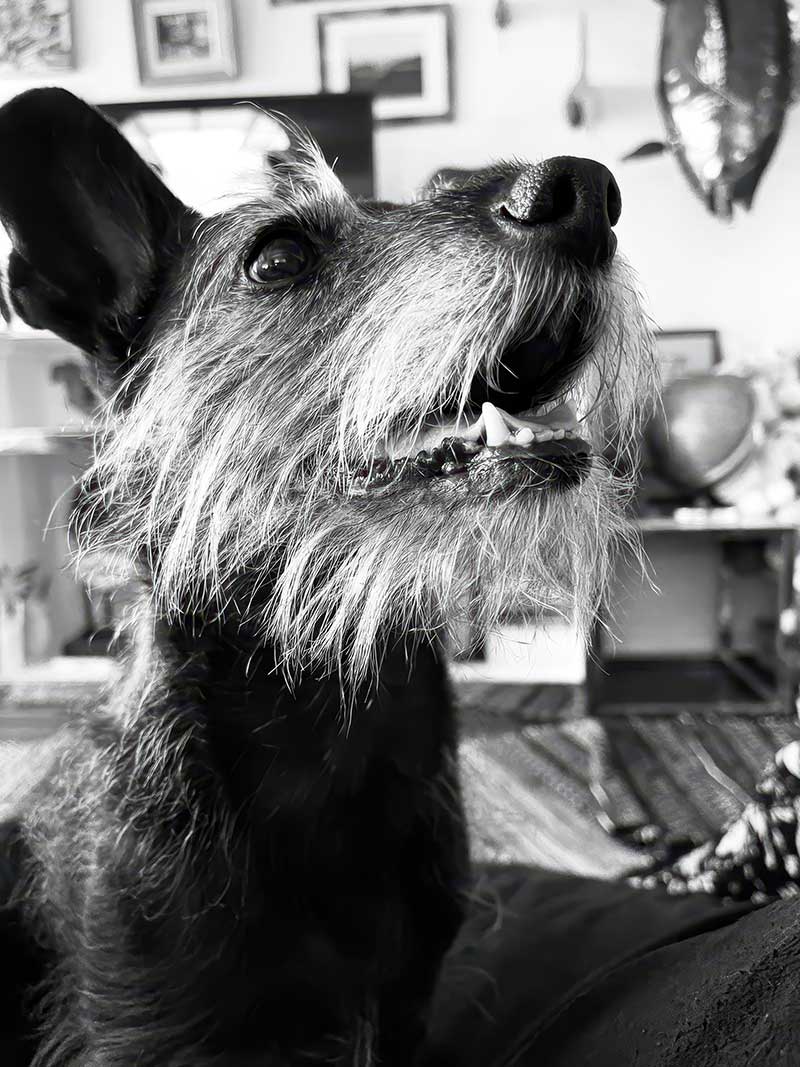
Trouble lived up to his name and was the Sean Connery of mutts
Care as Continuity
Dexter came into my life when my dear friend Alexandra was dying of cancer. She worried about him. I promised to love him as mine.
That promise gave her peace.
Dexter was the happiest dog I have ever known — a King Charles cavalier mix whose joy was immediate and contagious. He had an uncanny ability to read people: good or bad. I trusted his instincts. If he would not go near you and gave you side-eye, I knew.
Nick followed Trouble and Dexter home during COVID. Each time his owner retrieved him, he would escape and show up at my door. Finally, he said, "He is your dog."
Nick never tried to escape again. He chose his human.
Later came Beanie Montoya, my first foster-fail, a beagle-chihuahua mix who had spent his life caged in a backyard or locked in a bathroom. He was terrified of the world.
Trouble and Nick taught Beanie that it was safe to play, safe to explore. He gave Trouble so much joy in his final months. He brought the puppy out in both of them. In turn, Beanie pulled Nick back from grief after Trouble died.
Care, I learned, is never a one-way offering. It moves through a home like weather — passed from one being to another, reshaping everyone it touches.
Naming What Was Already True
When Dr. Stasiak became the veterinarian to four of my fur babies — three seniors and a puppy — we grew close as Trouble's health required weekly treatments over the past year. She and her staff became his guardians, ensuring that his quality of life remained exceptional despite his ailments.
Through her clinical work and our conversations, she helped me understand why animals who have known neglect often thrive once they experience consistent safety. Stability is not merely emotional comfort; it is physiological intervention. Bodies settle when environments become predictable.
She explained that trauma lives in the body — but that it does not prevent flourishing. Vigilance may remain. Sensitivities may persist. But joy, play, beauty and connection can still emerge when fear is no longer reinforced.
She helped me see care not as rescue, but as daily practice: routine, play, attention, reliability. She affirmed what experience had already shown me — that animals possess distinct, enduring personalities. History may shape them, but it does not erase individuality. They are not blank slates. They are themselves.
What veterinary medicine refers to as the human-animal bond is not sentimental. It is physiological, emotional and reciprocal.
Healthcare, she reminds us, is not merely clinical intervention. It is moral care.
Grace, she helped me understand, is not mercy. It is responsibility practiced with clarity and compassion.
Practice, Widened
Over time, that practice widened. It was not limited to the animals who shared my home. It looked like walking dogs at shelters so they could feel the world beyond concrete for an hour. Sitting on the floor and reading aloud to animals who had learned to associate human voices with abandonment. Showing up for friends navigating illness or loss, holding their companions when they could not.
Care, I learned, does not require ownership. It requires presence. Animals meet us wherever we are willing to be still, attentive and kind — and in doing so, they offer something rare: uncomplicated joy, mutual regulation and the quiet assurance that connection does not have to be earned to be real.
Grace, it turns out, is available to anyone willing to pay attention.
Grace
How we care for animals — especially when they are no longer convenient, healthy or easy — reveals how we understand grace. Whether we mistake it for comfort or recognize it as responsibility.
I have learned that this practice is not mine alone. It is shared by veterinarians who listen beyond charts, by shelter workers who show up day after day, by fosters, volunteers and quiet caregivers who choose presence over avoidance. It is practiced by people who understand that care is not heroic — it is cumulative.
Grace is found in the daily decisions that rarely look remarkable from the outside: slowing down, paying attention, honoring limits and choosing kindness when no one is watching. It lives in the willingness to listen when the answer is difficult, to let go when holding on would be easier and to place another being's well-being ahead of our own need for certainty.
Along the way, animals offer something in return — not as reward, but as relationship. They bring us back into rhythm with the living world. They teach us how to notice small shifts, how to trust the body's wisdom and how to remain open to beauty even in seasons of loss.
Grace, I have come to understand, is not an emotion we feel in moments of affection.
It is a way of moving through the world — one that lifts rather than dominates, listens rather than insists and recognizes that all living beings are worthy of care.
When practiced daily, grace does not simply change how we love animals.
It changes how we show up for one another.
In Memory of Pam Fischer and Sarah St. Claire





Grace fully encompasses my dear friend Dr. Laura. Thank you for this. I will re-read when ever I need a reminder that love & goodness exist. Especially in furry form.
Much love,
Natasha
WOW!! What an INCREDIBLY BEAUTIFUL story, Laura!! Brought me to tears–probably HOW YOUR WROTE ABOUT Grace did it!! God has certainly endowed YOU with a BEAUTIFUL way to write!! I thought, obviously mistakenly, I had the same ability; but, it is apparent I do NOT when compared to you!! You amaze me ever since I have had the pleasure of meeting you!!
What a wonderful testimony of your love of not only your fur/feather babies but everyone you meet. Your story brought tears to my eyes as I remembered all my fur babies though the years. Most as you wrote found me.
What a beautiful tribute to all of your fur babies and and an amazing reflection of the complexity of our human/animal connections. You are an amazing writer Dr Laura.