

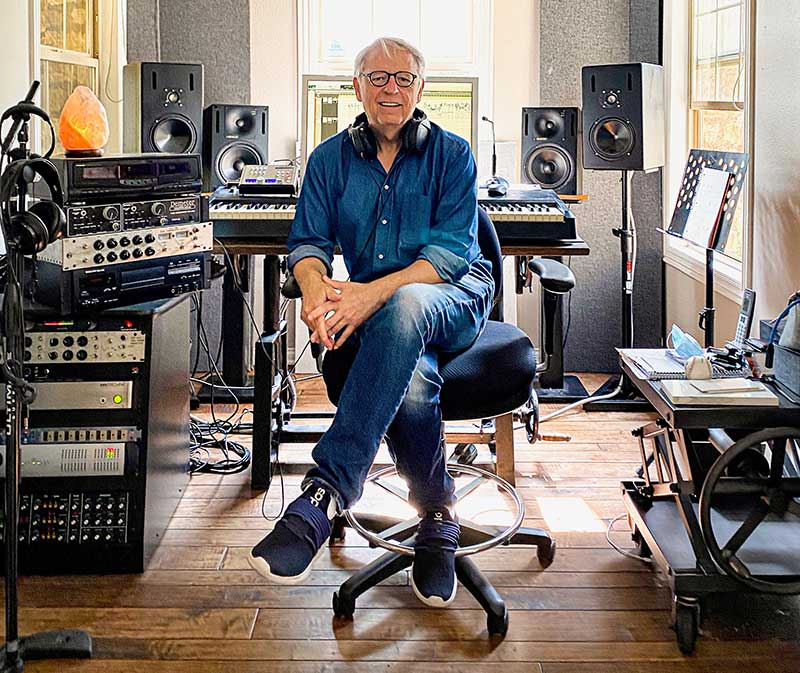
Producer John Parenti works in his Newport Coast, California, studio (Photo by Joni Parenti)
From Drumsticks to Destiny:
The Inspiring Musical Odyssey of John Parenti
BY SHERYL ARONSON
John Parenti's story begins in New Jersey, where a childhood encounter with music set the course for his life. At 4 years old, he walked in on his older brother's band and something ignited within him. "I saw the drummer in particular, and I knew I was going to do music for the rest of my life," Parenti remembers. Encouraged by his family, he received his first snare drum and later a drum set. The young boy practiced diligently and immersed himself in learning music.
The family's move to Las Vegas in 1972 marked a new chapter, intensifying Parenti's dedication. His father's nighttime visits to Circus Circus led to a mentorship with a professional drummer. "When I was 14, I would accompany my dad to Circus Circus almost every night — he enjoyed gambling. I was captivated by the drummer in the band that played during the trapeze acts. Night after night, I stood outside the cage, mesmerized, wishing I could be in there playing. Over time, I befriended the drummer, who was much older, and he allowed me to sit beside him as he played."
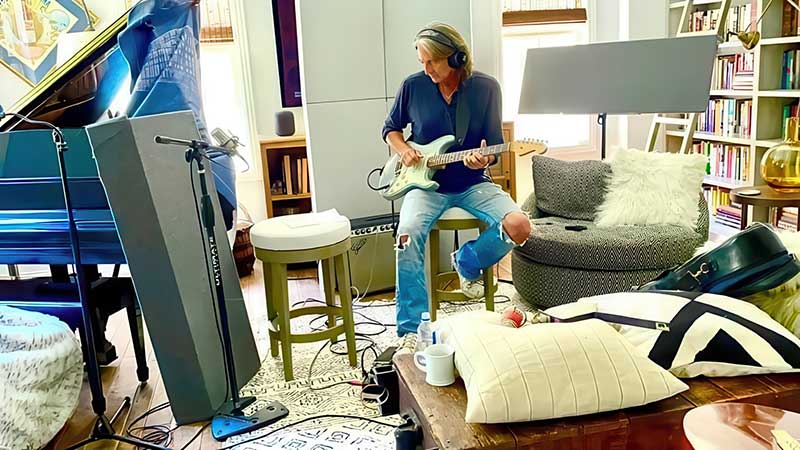
Guitarist Allen Hinds performs as a living room transforms into a live recording space (Photo by John Parenti)
For hours, two or three nights a week, Parenti watched the drummer perform intricate, rudimentary licks with precision. Eventually, he realized this was the person he wanted to learn from — not the teachers at the music stores. With his father's help, they approached the drummer about giving Parenti lessons.
At first, the drummer declined, saying he didn't give lessons because he was a professional. "But something 'changed hands' between him and my dad, because the next Saturday, he showed up at our house ready to give me a two-hour lesson," Parenti fondly says. "For about a year and a half, I received intensive, real-world instruction from him — forget the books, he was teaching me how to truly lead a band." After one particular lesson, the drummer told Parenti's father that the young musician was better than he was and that he couldn't teach Parenti anything more.
After outgrowing his teacher, Parenti joined amateur bands, playing jazz for inspiration and mastering rock and pop to break into the local music scene.
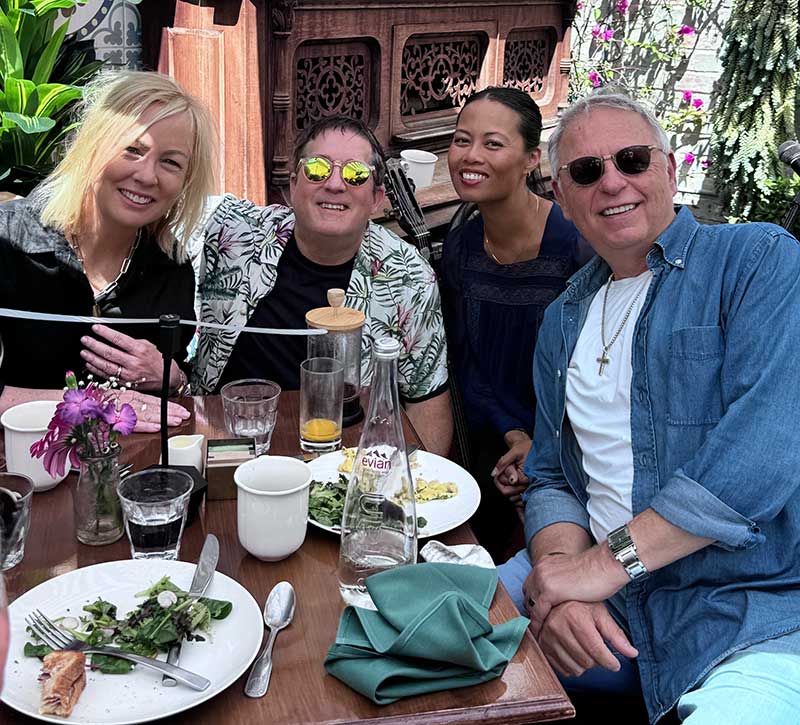
(L-R) Joni Parenti, gypsy jazz artists Jon Garner and Lorelei Isidro Garner and producer John Parenti (Photo by Bruce Richardson)
While a senior in high school, Parenti had a chance encounter that would shape his future. He walked into an empty church after hours and found Benny Hester, a Las Vegas singer-songwriter formerly signed to CBS Records, performing alone. Struck by the music, especially the songwriting, he sat down and listened, later telling him, "I've never heard music like this in my life." Their conversation revealed that Hester also owned a jingle business responsible for 90% of the jingles in Las Vegas and that he had seen Parenti play at a concert the previous night. Hester remarked, "Are you a drummer?" and when Parenti confirmed, Hester said, "Were you playing a concert last night? I was there." The odds of such a meeting were remarkable, and Hester's recognition of Parenti's talent was a pivotal moment.
Their connection quickly led to a bold proposal. Parenti recalls, "I just looked at him and said, 'Let's start a band.'" Although Hester initially hesitated, explaining, "I don't really have the players — all of the players in Elvis's 'Taking Care of Business' band had played on my first record in Las Vegas, but they were obviously not able to tour with me." Parenti was undeterred. He replied, "Don't worry, I know the band. I've got all the guys I play with in high school — they're serious musicians, they're incredible players."
Hester agreed, and with a handshake, they formed a band, marking the beginning of Parenti's professional career. "That was the beginning of my pro career and also the steering of my career toward what we call CCM, which is Contemporary Christian Music."
Touring followed across the U.S., with performances at Main Street, U.S.A. at Disneyland Park, the Oakland Coliseum and even on a Navy aircraft carrier. After forming their band, Parenti and Hester decided to cold-call Sparrow Records, the most elite Christian record label at the time. The CEO, Billy Ray Hearn, a legendary figure in Christian music, invited them to California to present their music in person. "Benny and I drove down to California; we had a three-song demo. I had just graduated from high school, and Benny was about 10 years older than me at the time."
When they arrived, they were ushered into Hearn's sprawling office, adorned with gold records. Parenti describes the scene: "He was a very amiable Texan, an older man, and he listened to our demo in front of us. He tapped his foot, he smiled — it seemed like it was just going fantastic." However, the meeting took an unexpected turn. "When the record got done, he just said, 'Thanks for coming. You boys are dime a dozen.'" The sting of rejection was immediate. Parenti reflects, "Talk about rejection — that's another big lesson you learn — tenacity. And if you're going to fail, fail forward."
Despite feeling dejected, they returned to Las Vegas, determined to practice harder, even though they weren't sure what would come next.
Three weeks later, in the middle of an afternoon rehearsal, the phone rang. It was Hearn from Sparrow Records. "He said, 'I've been thinking about you boys. You better get back down here right now.'" Parenti and Hester drove back to California the next day. This time, they met with Hearn and another label executive, Greg Nelson, a talented string arranger and composer. The four of them sat at lunch, and Hearn pulled out a napkin, asking, "How much do you think it costs to make a good record? We'll take care of all the sales, all the promotion, all the printing of the albums — just to go in the studio." Before Parenti and Hester could answer, Hearn offered, "How about $50,000?" — a staggering sum, equivalent to several hundred thousand dollars today.
Parenti remembers, "We were flabbergasted. We had nothing but a demo, but he had a lot of faith in us."
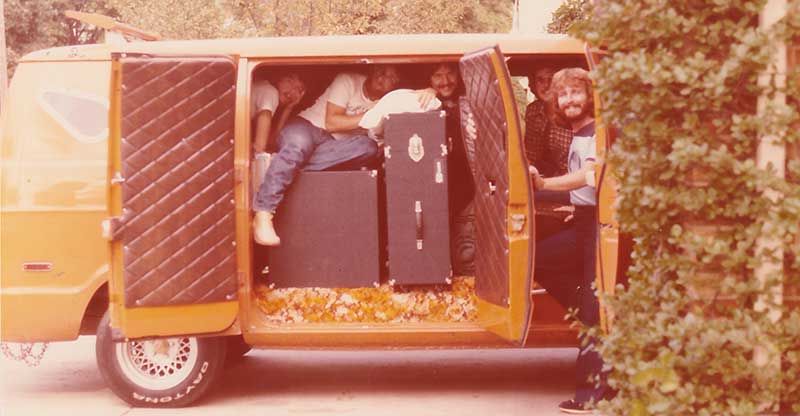
Driving into Chicago after one of the touring vehicles broke down
With this leap of faith, they soon found themselves in Nashville, working under the guidance of renowned producer Brent Maher. "He was the engineer for 'Proud Mary' and 'Age of Aquarius' and went on later to discover The Judds and write their hits and produce their music."
The experience was transformative for Parenti: "Under his direction, I flourished. I still draw from his professionalism, his preparation and all the things he taught me during those three weeks in every session I do to this day. He was such a mentor." It was a major milestone in his career.
After touring, Parenti transitioned to radio, hosting the morning drive-time show at KILA in Las Vegas and a homemaker show. "As a 21-year-old kid, I knew nothing about the topic, but being a DJ was fun and we had big ratings. It was a blast."
After years of building his reputation in music production, Parenti faced a major decision about where to base his career. Despite knowing that Hollywood might offer more opportunities, he chose the quality of life in Orange County, California, believing, "I'll just create the best career that I can, living in a beach town, but I'm not doing Sunset Boulevard in Hollywood."
As a natural progression, Parenti's music evolved from that of a musician to a composer. His most notable and memorable work was a song he co-wrote with Hester for the burgeoning CCM pop market. Taking inspiration from a Bible study he had recently taught on the parable of the Prodigal Son, Parenti penned "When God Ran." It quickly climbed to No. 1 on the airplay charts in 1985. Astonishingly, it held its No. 1 position for a record 13 consecutive weeks. It has since been re-recorded multiple times by various artists and again reached No. 1 in each of the last three decades. Word Records named it the No. 3 most important song of the 20th century. Adding to his successful songwriting run, in the same year, two other songs that Parenti co-wrote also achieved No. 1 status in other national CCM categories — the first time a composer has held three simultaneous national No. 1s.
In the early 1990s, his career took a new direction as he built his own recording studio and hung out his "record producer" shingle. He began by working with a wide range of musical genres. "I was producing music in the style of the Beastie Boys and Whitney Houston-type ballads; I was doing country — I even did rap songs for an NBC Movie of the Week. Those were my learning years — how to produce the different genres of music authentically." This versatility set the stage for an unexpected opportunity: a cold call from a large advertising agency in Orange County. They told Parenti they had a bunch of commercials to get done and their in-house guy wasn't available. "Can you come to our studio and do our commercials for us?" Despite knowing little about commercials or the advertising world, he dove in, quickly adapting and learning on the job. "I was really in over my head, but I was having a really good time."
A chance meeting with Hal Brice, the agency owner, led to a transformative partnership. Inspired by the creative energy of the agency, Parenti pitched a bold idea to Brice. "I put my idea down, as they say, on one sheet of paper — 'I'd like to move my recording studio into your advertising agency and do all your commercials from now on and compose all your jingles … I'll be embedded here with all my expensive high-end gear, so I'll make better sounding commercials than you have now. And you can show off my studio to your potential clients. I'll make my records, write your jingles and do your commercials.'"
Brice said, "We love music" and he accepted. For the next 20 years, Parenti's studio operated inside the agency's facilities. This arrangement became a conduit for him to produce more than 10,000 radio commercials and about 70 jingles for major brands like IHOP, the Los Angeles Times, the Los Angeles Clippers and Marie Callender's.
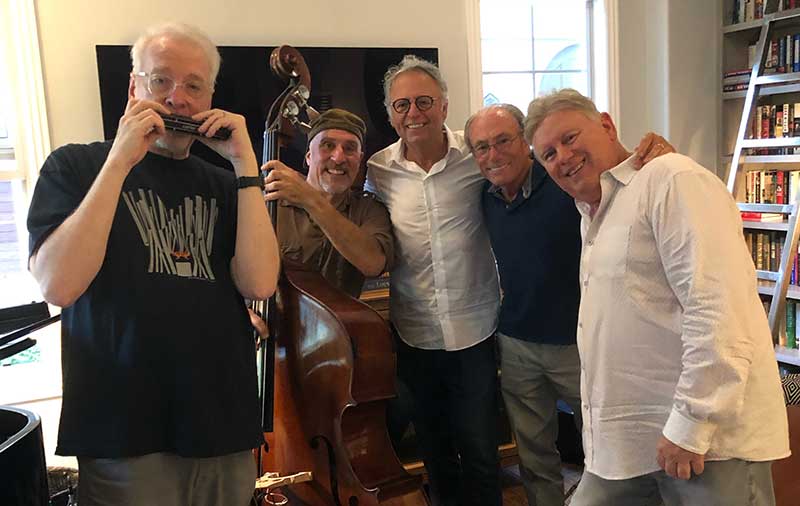
A record release party with Nicolaas tenBroek, Roberto Vally, John Parenti, John Giannone and Patrick Woodland
“There were many fun sessions with lots of celebrities, and really great times scoring music for commercials that lasted for that 20-year span.”
As technology advanced, Parenti adapted by moving his studio home and embracing the work-home balance: "I decided to move my studio back home and let go of much of my oversized analog equipment and start doing almost all of my work in what we call 'in the box' — we record, we mix, we arrange, we master all of our records on a Mac. My control room is my former dining room."
He describes the benefits: "The beauty of working this way is everything is recallable — working on multiple records at once becomes so efficient and mixing deep into the night becomes easy, so I once again reinvented how my career worked and how I produced music."
Parenti now works both one-on-one with artists, overdubbing each instrument one at a time and in full band sessions with top Hollywood musicians. "Sometimes you just want a band, and you want all the musicians in the room at the same time. Magic happens because they start inspiring each other and spontaneous creativity occurs that could never be created in any other way. I've spent decades establishing close relationships with LA's elite session players and it's an honor to have the best of the best play on my tracks."
Summing up his career, Parenti emphasizes the importance of hard work and versatility: "Young musicians need to spend hours learning their craft... there's no shortcut to that... have a lot of musical versatility, learn a lot of different styles of music, learn theory, learn several instruments and it will pay you back tremendously."
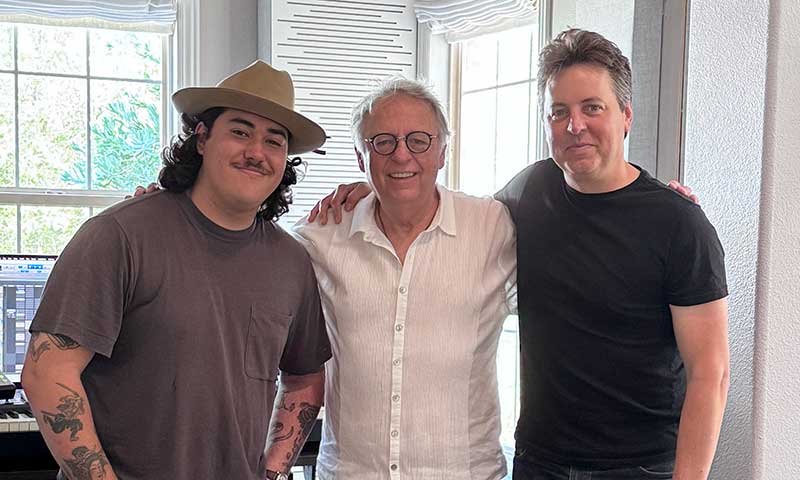
Bassist Sean Hurley records during a session for Sebastian Bird (Photo by Joni Parenti)
He also stresses the value of initiative: "Be extremely proactive, make the call, start the project, send the email, because 20 years is going to go by in a flash... don't wait to be ready to start because you'll never be ready. And when a window of opportunity opens, even through a brief conversation... recognize it. Take a chance, bet on yourself."
Currently, Parenti is producing and recording a range of talented artists, including Sebastian Bird ("a folk artist reminiscent of the 60s folk artists with a fast vibrato"), Daniel Kristof ("a powerful blues rock singer"), Jon Garner ("a gypsy jazz guitarist who is one of the finest lyricists I know"), Sydney Cohen ("a great singer/writer in the vein of Sabrina Carpenter"), Sophia Rollando ("a fabulously big voice and a writer of hook after hook") and Wyatt Michael ("a jazz artist in the old standards style of jazz... when he sings, you're brought back to Sinatra, you're thinking Michael Bublé and he is one of the most gifted vocalists I've ever heard"). Michael's album will be an homage to the past but will be very contemporary and have a lot of musical surprises. "With Wyatt now a Las Vegas resident," Parenti adds, "everyone in Las Vegas should get excited about this record that we'll be starting this spring."
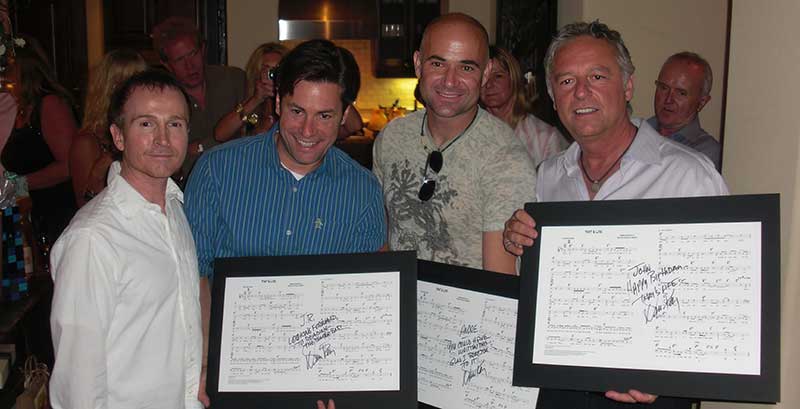
John Parenti celebrates his 50th birthday with close friends: (L-R) Recording artist and TV producer Benny Hester, Pulitzer Prize-winning, best-selling author J. R. Moehringer, tennis star Andre Agassi and John Parenti
Most recently, Parenti is forming a new record label, Lido Records. "Having a label will enable me to make more music more efficiently and give my artists better distribution, a more effective social media presence and overall give them a greater platform to succeed. Lido Records is going to punch above its weight and make a true impact in the music industry."
For more information, visit parentimusic.com.
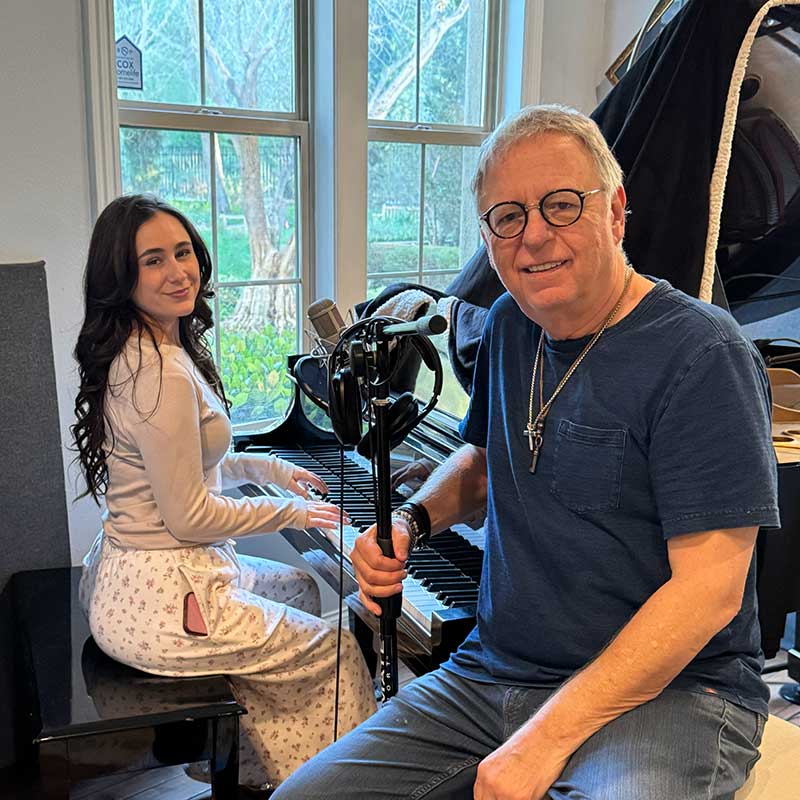
John Parenti during a preproduction session with Sophia Rollando
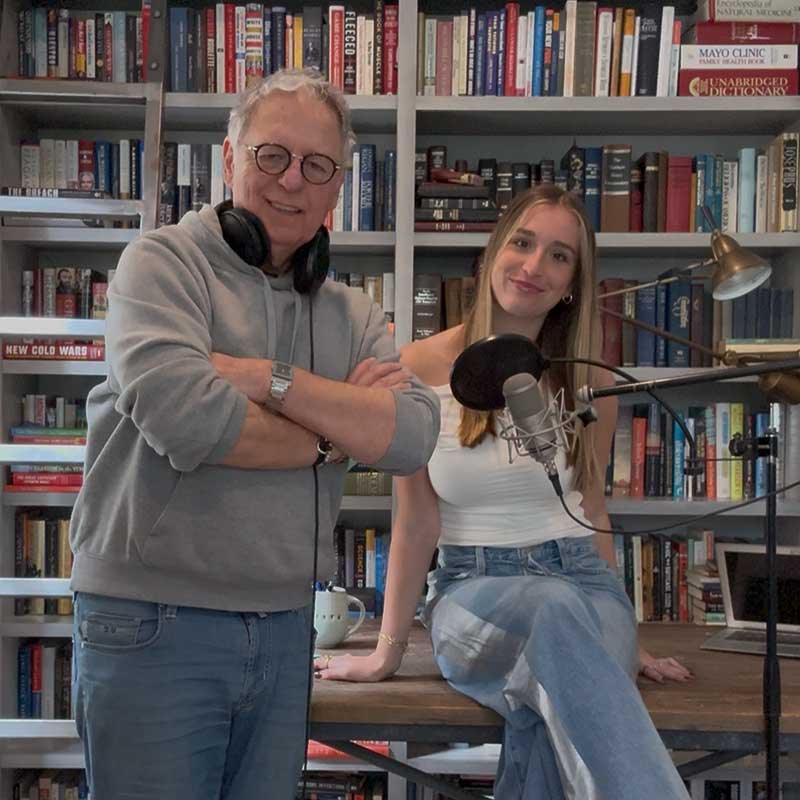
John Parenti with artist Sydney Cohen in his Newport Coast studio
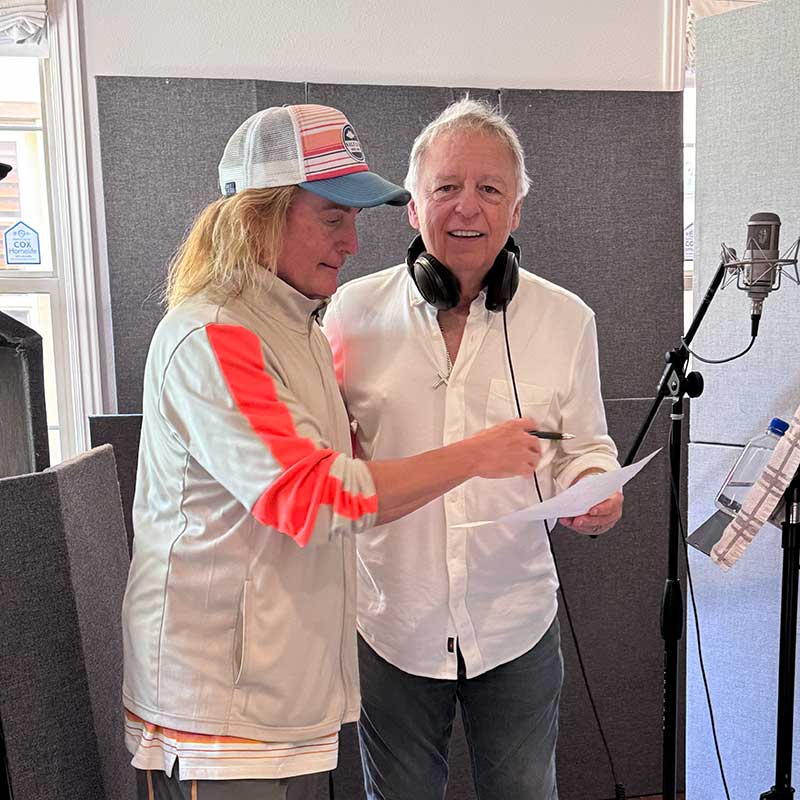
John Parenti with country and rock artist Daniel Kristof in his Irvine studio